> ## Documentation Index
> Fetch the complete documentation index at: https://docs.haloxlabs.ai/llms.txt
> Use this file to discover all available pages before exploring further.
# Prompt Status: track AI question sets, mentions, sources, and citations
> HaloX Prompt Status manages brand, non-brand, comparison, and buying question sets while repeatedly measuring mention, source, and citation signals across AI answers.
## What is this feature?
**Prompt Status** manages the questions HaloX measures repeatedly in AI search. It is not a one-off prompt tester; it groups branded, non-branded, comparison, buying, and local questions into operating sets.
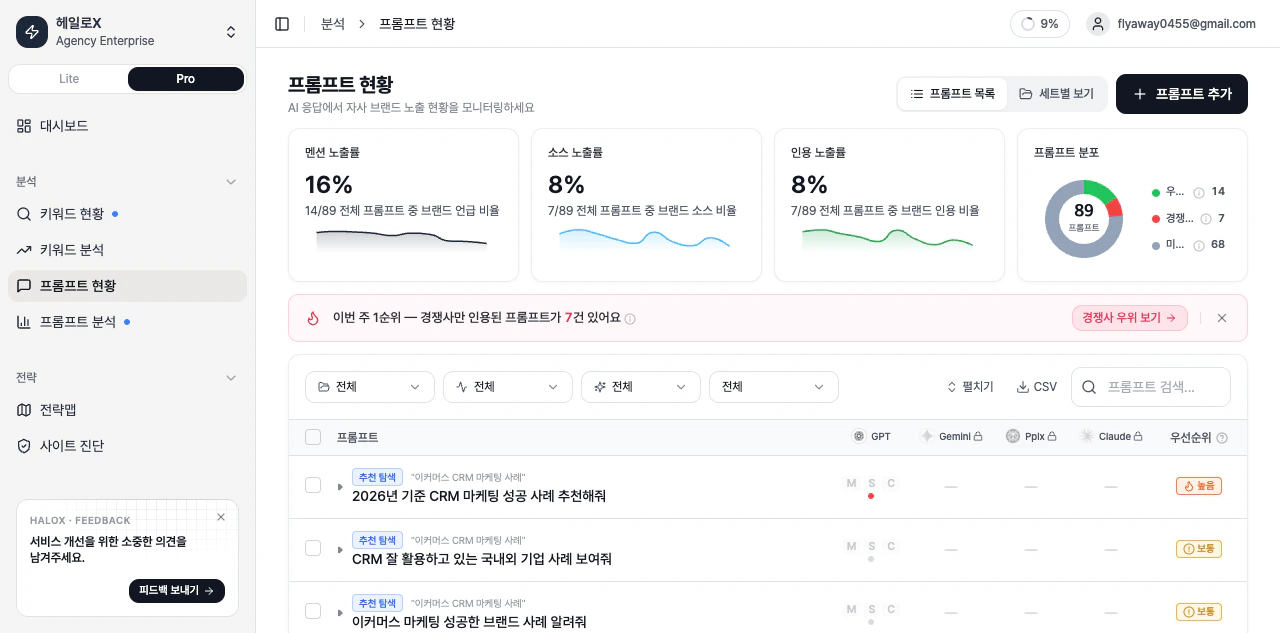 *Prompt Status uses list/set toggles, KPI cards, filters, CSV export, the add-prompt button, and live prompt rows to make mention, source, and citation tracking repeatable. This account screenshot keeps the Pro sidebar, page heading, KPI cards, distribution chart, and table context visible together.*
## Key tabs
Review answer, brand mention, source exposure, citation status, and competitor presence for each question.
Manage branded, non-branded, comparison, buying, and local questions as recurring measurement groups.
## Signals to separate
| Signal | Meaning | Next action |
| ---------- | ----------------------------------------- | -------------------------------------------------------------- |
| Mention | Whether the brand appears in AI answers | Improve entity and brand explanation pages |
| Source | Which sources AI uses | Improve official pages, external sources, and Evidence Library |
| Citation | Whether your URL is cited | Use Citation Tracking, Site Audit, and content structure fixes |
| Competitor | Whether competitors are recommended first | Create comparison content and strengthen PR sources |
## KPI cards and M/S/C meanings
| Signal | What it means | Basis | Example reading |
| ------------------ | ----------------------------------------------------- | ------------------------------------------------------------- | -------------------------------------------------------------------------------- |
| M, Mention | The brand name appears in the AI answer text | Latest engine run has a brand mention | If M exists without C, AI names the brand but does not use it as a cited source. |
| S, Source | AI uses the brand domain as supporting evidence | Brand source count exists or source-but-not-cited is detected | S without C is a hidden opportunity. |
| C, Citation | The brand URL/domain appears as a final cited source | Latest engine run has a brand citation | This is the strongest GEO outcome signal. |
| Hidden Opportunity | Prompt has Source but no Citation | Source detected, final citation missing | Improve page structure and answer fit to convert into citation. |
| Ghost Citation | Brand URL is cited, but the brand is not mentioned | Citation true, Mention false | The source is found, but brand recall is weak. |
| Mention-only | Brand is mentioned, but the brand source is not cited | Mention true, Citation false | Source credibility is the priority. |
## Reading competitor citation status
| Status | Meaning | Next action |
| --------------- | ------------------------------------------ | -------------------------------------------------------------------------------- |
| Competitor-only | Competitors are cited and the brand is not | Compare competitor source pages and strengthen the matching brand evidence page. |
| Competing | Brand and competitors are cited together | Compare source order and evidence quality to move the brand forward. |
| Our-exclusive | Only the brand is cited | Treat it as a defended prompt and use it as report evidence. |
## Example decisions
| Situation | Interpretation | Next action |
| -------------------------- | ------------------------------------------------------------- | ------------------------------------------------------------------ |
| M is high, but C is low | AI names the brand but does not select brand sources | Strengthen official source links, FAQ sections, and case evidence. |
| S exists, but C is missing | AI considered the source but excluded it from final citations | Use the Hidden Opportunity filter and prioritize these pages. |
| Only competitors have C | Competitors own the AI-answer source slot | Compare competitor cited pages with the brand response page. |
## If you need the service metric definitions
Terms such as `rank`, `search volume`, `trend`, `AI`, `PAA`, `Citation Rate`, `Share of Voice`, and `gap type` are explained in the [screen metrics glossary](/en/glossary/screen-metrics). Use it when a KPI on this page needs a plain-language definition and a link back to the screen where it appears.
## Related docs
See where this feature sits in Pro mode.
Translate metrics into meeting language.
Turn signals into execution instructions.
Package findings for clients and executives.
*Prompt Status uses list/set toggles, KPI cards, filters, CSV export, the add-prompt button, and live prompt rows to make mention, source, and citation tracking repeatable. This account screenshot keeps the Pro sidebar, page heading, KPI cards, distribution chart, and table context visible together.*
## Key tabs
Review answer, brand mention, source exposure, citation status, and competitor presence for each question.
Manage branded, non-branded, comparison, buying, and local questions as recurring measurement groups.
## Signals to separate
| Signal | Meaning | Next action |
| ---------- | ----------------------------------------- | -------------------------------------------------------------- |
| Mention | Whether the brand appears in AI answers | Improve entity and brand explanation pages |
| Source | Which sources AI uses | Improve official pages, external sources, and Evidence Library |
| Citation | Whether your URL is cited | Use Citation Tracking, Site Audit, and content structure fixes |
| Competitor | Whether competitors are recommended first | Create comparison content and strengthen PR sources |
## KPI cards and M/S/C meanings
| Signal | What it means | Basis | Example reading |
| ------------------ | ----------------------------------------------------- | ------------------------------------------------------------- | -------------------------------------------------------------------------------- |
| M, Mention | The brand name appears in the AI answer text | Latest engine run has a brand mention | If M exists without C, AI names the brand but does not use it as a cited source. |
| S, Source | AI uses the brand domain as supporting evidence | Brand source count exists or source-but-not-cited is detected | S without C is a hidden opportunity. |
| C, Citation | The brand URL/domain appears as a final cited source | Latest engine run has a brand citation | This is the strongest GEO outcome signal. |
| Hidden Opportunity | Prompt has Source but no Citation | Source detected, final citation missing | Improve page structure and answer fit to convert into citation. |
| Ghost Citation | Brand URL is cited, but the brand is not mentioned | Citation true, Mention false | The source is found, but brand recall is weak. |
| Mention-only | Brand is mentioned, but the brand source is not cited | Mention true, Citation false | Source credibility is the priority. |
## Reading competitor citation status
| Status | Meaning | Next action |
| --------------- | ------------------------------------------ | -------------------------------------------------------------------------------- |
| Competitor-only | Competitors are cited and the brand is not | Compare competitor source pages and strengthen the matching brand evidence page. |
| Competing | Brand and competitors are cited together | Compare source order and evidence quality to move the brand forward. |
| Our-exclusive | Only the brand is cited | Treat it as a defended prompt and use it as report evidence. |
## Example decisions
| Situation | Interpretation | Next action |
| -------------------------- | ------------------------------------------------------------- | ------------------------------------------------------------------ |
| M is high, but C is low | AI names the brand but does not select brand sources | Strengthen official source links, FAQ sections, and case evidence. |
| S exists, but C is missing | AI considered the source but excluded it from final citations | Use the Hidden Opportunity filter and prioritize these pages. |
| Only competitors have C | Competitors own the AI-answer source slot | Compare competitor cited pages with the brand response page. |
## If you need the service metric definitions
Terms such as `rank`, `search volume`, `trend`, `AI`, `PAA`, `Citation Rate`, `Share of Voice`, and `gap type` are explained in the [screen metrics glossary](/en/glossary/screen-metrics). Use it when a KPI on this page needs a plain-language definition and a link back to the screen where it appears.
## Related docs
See where this feature sits in Pro mode.
Translate metrics into meeting language.
Turn signals into execution instructions.
Package findings for clients and executives.