> ## Documentation Index
> Fetch the complete documentation index at: https://docs.haloxlabs.ai/llms.txt
> Use this file to discover all available pages before exploring further.
# Generative Engine Optimization: meaning and HaloX use cases
> Learn what Generative Engine Optimization means for GEO, AI search visibility, citations, source readiness, and HaloX reporting workflows.
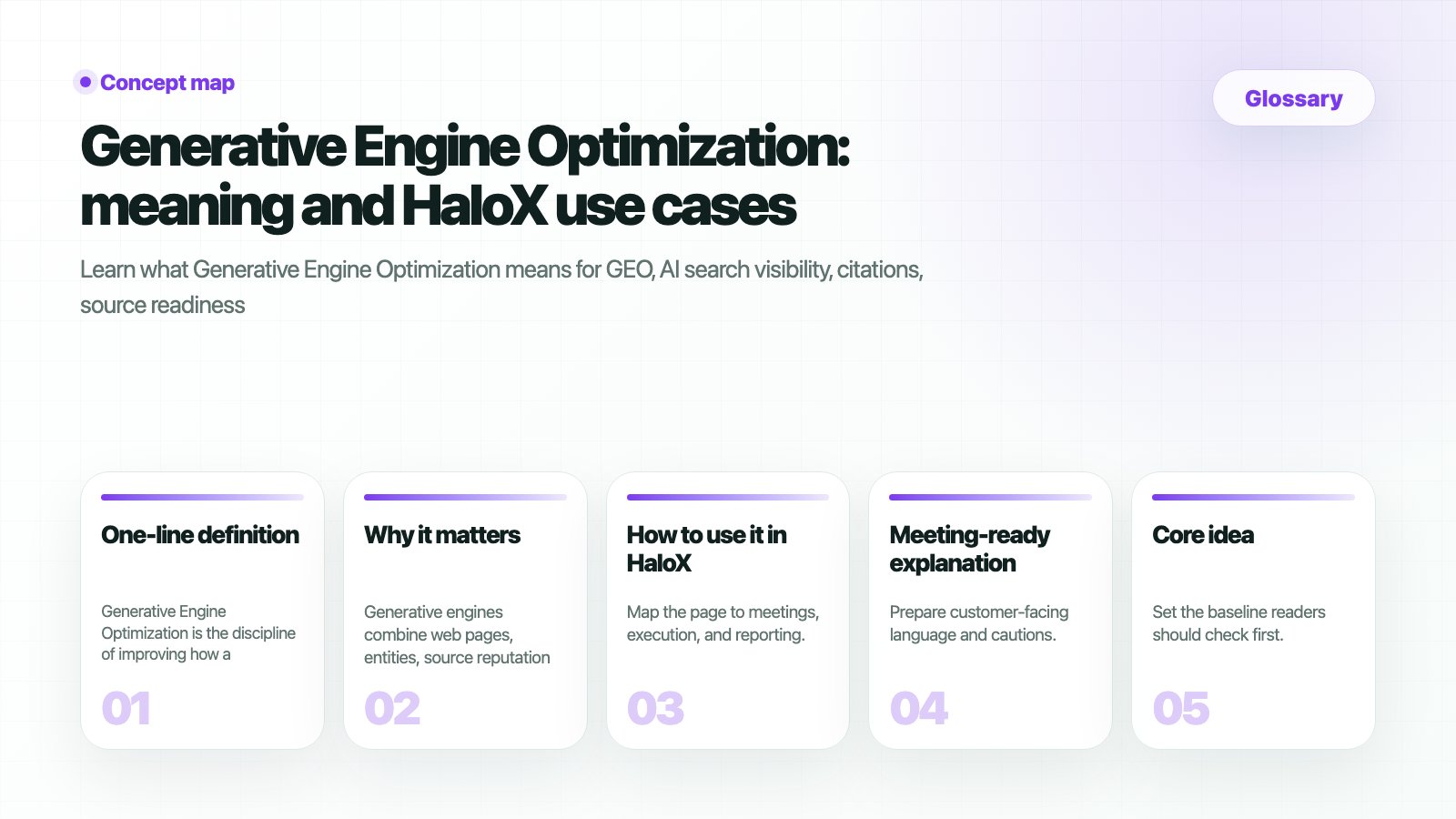 ## One-line definition
**Generative Engine Optimization** is the discipline of improving how a brand is understood, mentioned, sourced, and cited by generative answer engines such as ChatGPT, Gemini, Perplexity, Claude, and Google AI Overview. In HaloX, it becomes a measurable operating loop: define the prompt market, check answer visibility, inspect source evidence, and turn gaps into content or technical work.
## Why it matters
Generative engines combine web pages, entities, source reputation, and answer patterns differently from classic search results. That makes it risky to measure only rankings or traffic. Teams need to know whether their brand is present in the answer, whether the right evidence is attached, and whether the next content update is likely to become reusable source material.
| Perspective | Question to ask | Where HaloX helps |
| ----------- | -------------------------------------------- | --------------------------------------------------- |
| Discovery | Does AI know the brand or content? | Prompt Analysis, Citation Tracking, Content Factory |
| Mention | Does the brand appear in the answer? | Prompt Analysis, AVI |
| Source | Can owned or external assets become sources? | Citation Tracking, Site Audit |
| Citation | Are target URLs attached as citations? | Citation rate, Content Factory |
| Execution | What should change this week? | Strategy Map, weekly reports |
## How to use it in HaloX
Include branded and non-branded prompts first. Add comparison, buying-review, local, and vertical prompts as separate groups so the signal can be measured over time.
Decide whether the weak signal comes from technical access or content gaps. Then check source weakness and question coverage.
Turn the signal into a Content Factory brief or Site Audit fix. If the problem is external, create an offsite source task and record it in the weekly report.
## Relationship with SEO, AIO, AEO, LLMO, and GEO
| Area | Relationship |
| ---- | ---------------------------------------------------------------------------------- |
| SEO | Builds the foundation that search engines and AI systems can crawl and understand. |
| AIO | Focuses on AI summaries such as Google AI Overview. |
| AEO | Structures content for answer engines and direct answers. |
| LLMO | Helps language models understand the brand, entities, and source relationships. |
| GEO | Combines these signals into an AI answer visibility operating system. |
## Practical examples
| Situation | Weak interpretation | HaloX interpretation |
| -------------------------- | --------------------------- | ------------------------------------------------------------------- |
| The score is low | “Write more content.” | Identify which prompts, sources, or technical foundations are weak. |
| The brand is mentioned | “AI search is solved.” | Mentions and owned-source citations are different. |
| A competitor appears often | “They have more awareness.” | Check non-branded and comparison prompts plus source selection. |
| A report is needed | “Share the score.” | Explain movement, cause, and next action. |
## Meeting-ready explanation
> “Generative Engine Optimization helps us understand how AI recognizes the brand, which evidence it uses, and what content or source work should happen next.”
## FAQ
### Does improving Generative Engine Optimization immediately improve AI search performance?
No. It is an operating signal. Results improve when technical access, content structure, source trust, and monitoring move together.
### Is it separate from SEO?
No. It extends SEO. A weak SEO foundation usually weakens GEO performance as well.
### How often should teams check it?
Track core prompt sets weekly. Capture additional snapshots around launches, PR events, major content updates, and competitor changes.
## Related docs
Start the operating workflow.
Translate metrics into decisions.
Inspect answer sources and citations.
Browse related GEO terms.
## One-line definition
**Generative Engine Optimization** is the discipline of improving how a brand is understood, mentioned, sourced, and cited by generative answer engines such as ChatGPT, Gemini, Perplexity, Claude, and Google AI Overview. In HaloX, it becomes a measurable operating loop: define the prompt market, check answer visibility, inspect source evidence, and turn gaps into content or technical work.
## Why it matters
Generative engines combine web pages, entities, source reputation, and answer patterns differently from classic search results. That makes it risky to measure only rankings or traffic. Teams need to know whether their brand is present in the answer, whether the right evidence is attached, and whether the next content update is likely to become reusable source material.
| Perspective | Question to ask | Where HaloX helps |
| ----------- | -------------------------------------------- | --------------------------------------------------- |
| Discovery | Does AI know the brand or content? | Prompt Analysis, Citation Tracking, Content Factory |
| Mention | Does the brand appear in the answer? | Prompt Analysis, AVI |
| Source | Can owned or external assets become sources? | Citation Tracking, Site Audit |
| Citation | Are target URLs attached as citations? | Citation rate, Content Factory |
| Execution | What should change this week? | Strategy Map, weekly reports |
## How to use it in HaloX
Include branded and non-branded prompts first. Add comparison, buying-review, local, and vertical prompts as separate groups so the signal can be measured over time.
Decide whether the weak signal comes from technical access or content gaps. Then check source weakness and question coverage.
Turn the signal into a Content Factory brief or Site Audit fix. If the problem is external, create an offsite source task and record it in the weekly report.
## Relationship with SEO, AIO, AEO, LLMO, and GEO
| Area | Relationship |
| ---- | ---------------------------------------------------------------------------------- |
| SEO | Builds the foundation that search engines and AI systems can crawl and understand. |
| AIO | Focuses on AI summaries such as Google AI Overview. |
| AEO | Structures content for answer engines and direct answers. |
| LLMO | Helps language models understand the brand, entities, and source relationships. |
| GEO | Combines these signals into an AI answer visibility operating system. |
## Practical examples
| Situation | Weak interpretation | HaloX interpretation |
| -------------------------- | --------------------------- | ------------------------------------------------------------------- |
| The score is low | “Write more content.” | Identify which prompts, sources, or technical foundations are weak. |
| The brand is mentioned | “AI search is solved.” | Mentions and owned-source citations are different. |
| A competitor appears often | “They have more awareness.” | Check non-branded and comparison prompts plus source selection. |
| A report is needed | “Share the score.” | Explain movement, cause, and next action. |
## Meeting-ready explanation
> “Generative Engine Optimization helps us understand how AI recognizes the brand, which evidence it uses, and what content or source work should happen next.”
## FAQ
### Does improving Generative Engine Optimization immediately improve AI search performance?
No. It is an operating signal. Results improve when technical access, content structure, source trust, and monitoring move together.
### Is it separate from SEO?
No. It extends SEO. A weak SEO foundation usually weakens GEO performance as well.
### How often should teams check it?
Track core prompt sets weekly. Capture additional snapshots around launches, PR events, major content updates, and competitor changes.
## Related docs
Start the operating workflow.
Translate metrics into decisions.
Inspect answer sources and citations.
Browse related GEO terms.