> ## Documentation Index
> Fetch the complete documentation index at: https://docs.haloxlabs.ai/llms.txt
> Use this file to discover all available pages before exploring further.
# How to appear as a source in AI answers
> Prepare official pages for Perplexity, Google AI Overview, and AI answer citations by improving source trust, structure, and crawlability.
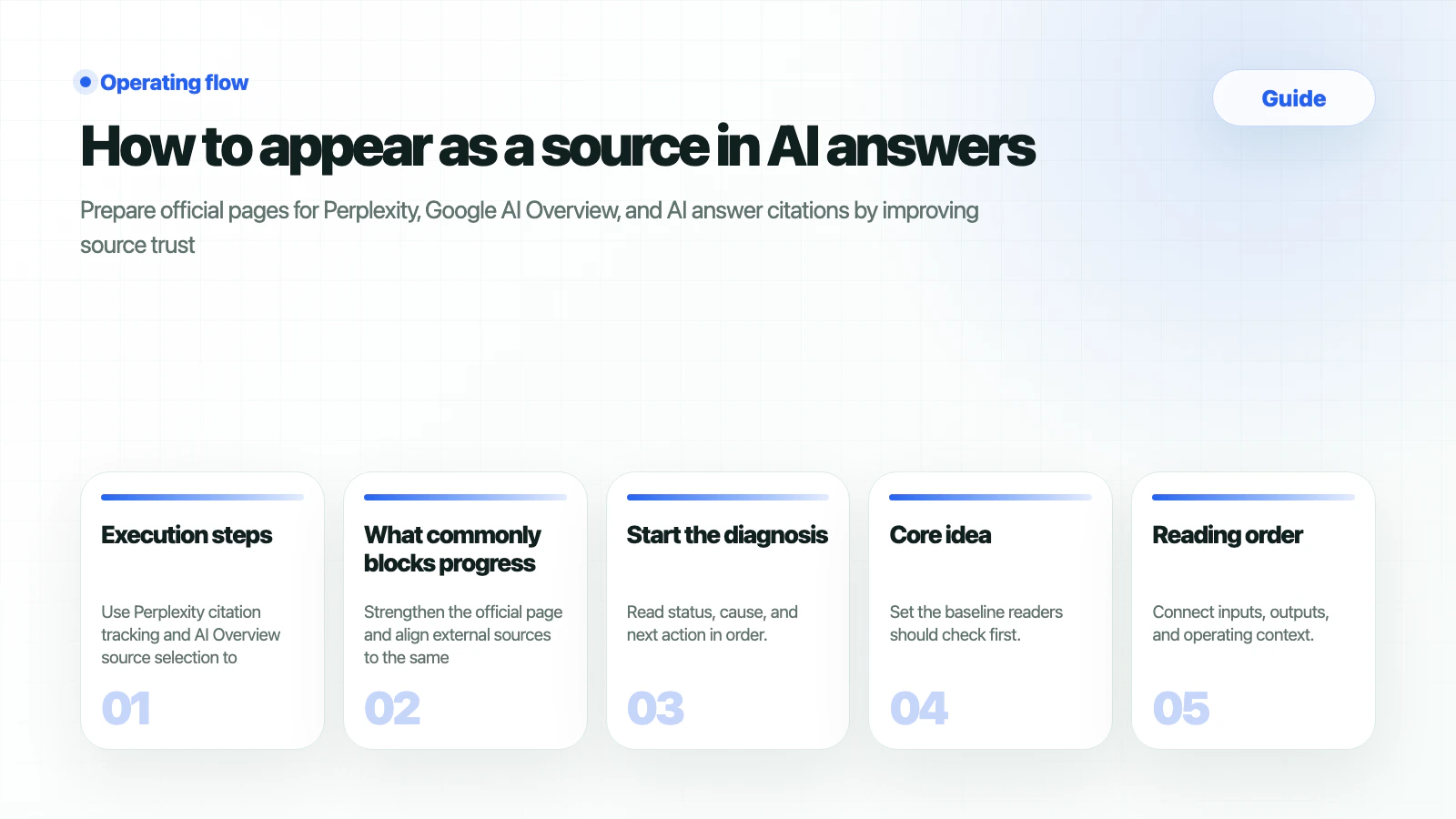 Appearing as a source in AI answers requires more than publishing a good article. AI systems need evidence that is clear, current, structured, trustworthy, and easy to crawl.
Use this guide for intents such as “how to appear in Perplexity sources,” “AI answer citation tracking,” “AI citation readiness,” and “official website AI citations.”
## What should you prepare
| Input | Why it matters |
| --------------------------- | ------------------------------------------------------------------------ |
| Target citation URL | Defines which official page should become evidence. |
| Prompt set | Repeats the questions where citations matter. |
| Current citation candidates | Shows which sources currently win. |
| Trust signals | Author
Appearing as a source in AI answers requires more than publishing a good article. AI systems need evidence that is clear, current, structured, trustworthy, and easy to crawl.
Use this guide for intents such as “how to appear in Perplexity sources,” “AI answer citation tracking,” “AI citation readiness,” and “official website AI citations.”
## What should you prepare
| Input | Why it matters |
| --------------------------- | ------------------------------------------------------------------------ |
| Target citation URL | Defines which official page should become evidence. |
| Prompt set | Repeats the questions where citations matter. |
| Current citation candidates | Shows which sources currently win. |
| Trust signals | Author
date
evidence
schema
FAQ
internal links. |
## Execution steps
Use [Perplexity citation tracking](/en/guides/perplexity-citation-tracking) and [AI Overview source selection](/en/guides/ai-overview-source-selection) to capture source URLs.
Use the [Source trust checklist](/en/guides/source-trust-checklist) to review officialness, freshness, specificity, schema, and links.
Add definitions, comparison criteria, data points, FAQs, examples, and evidence links in sections AI systems can reuse.
Track citation URL changes, official-source share, competitor sources, and next actions in weekly reports.
## How do you verify
| Signal | Good sign | Related concept |
| ----------------- | ------------------------------------------------ | --------------------------------------------------- |
| Citation rate | Target URLs appear as sources. | [Citation Rate](/en/glossary/citation-rate) |
| Source visibility | Owned and external assets are candidate sources. | [Source Visibility](/en/glossary/source-visibility) |
| AI crawler access | AI systems can read the page. | [AI Crawler](/en/glossary/ai-crawler) |
| Schema clarity | Entity and FAQ meaning is clear. | [Schema Markup](/en/glossary/schema-markup) |
## What commonly blocks progress
Strengthen the official page and align external sources to the same entity story. The goal is not to remove external proof but to make the official source reliable.
Quantity is not enough. Check definitions, tables, FAQs, evidence, crawlability, and source relationships.
No. Track engines separately, but treat officialness, access, structure, and trust as shared foundations.
## Start the diagnosis
Move the brand name, primary URL, competitors, and problem prompts from this guide into the HaloX app. Docs explain the decision criteria; the app shows the live scores, evidence, and report workflow.
Enter the primary URL and target prompts to create the first AI visibility baseline.
New teams should confirm the workspace, site diagnosis, and first report sentence.
Connect AI visibility diagnosis, ChatGPT brand mention checks, and Perplexity source checks to lead capture.
Choose the first 30-day operating scope for internal, agency, PR, B2B, or local-brand teams.
## Related docs
* [Perplexity source management](/en/guides/perplexity-source-management)
* [AI Overview source selection](/en/guides/ai-overview-source-selection)
* [Content Grounding](/en/glossary/content-grounding)