> ## Documentation Index
> Fetch the complete documentation index at: https://docs.haloxlabs.ai/llms.txt
> Use this file to discover all available pages before exploring further.
# B2B SaaS GEO guide
> How B2B SaaS teams can use HaloX for SEO recovery, non-brand questions, comparison intent, and content clusters.
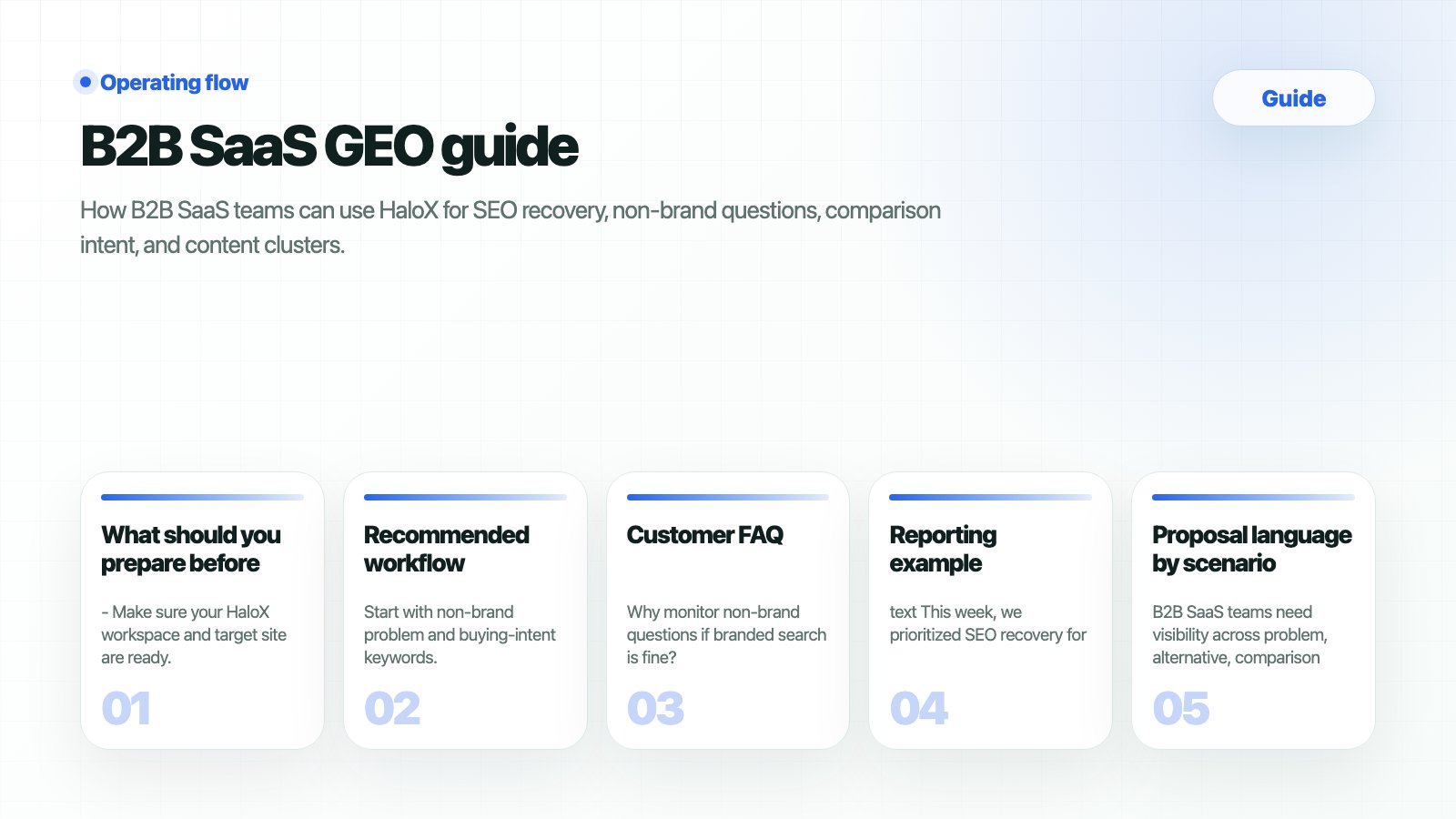 B2B SaaS buyers ask about problems, alternatives, comparisons, and buying criteria before searching for a brand. In real customer conversations, some teams needed SEO recovery before GEO expansion, and the recurring advice was to rebuild topics as **content clusters**, not isolated posts.
## What should you prepare before starting?
* Make sure your HaloX workspace and target site are ready.
* Keep GSC/GA4 access and any existing SEO or meeting notes nearby.
* Decide where the output will live: internal note, client report, or weekly operating document.
## How do you verify the result?
| Check | Healthy state | Next action |
| ------------------ | ----------------------------------------------------------- | ------------------------------------------------------- |
| Workflow completed | The requested audit or reporting task is finished | Reflect the result in Strategy Map and the right report |
| Priority selected | The next keyword, page, or content opportunity is clear | Assign an owner and due date |
| Evidence recorded | The metrics and reasoning can be reused in the next meeting | Track the same signals next week |
## What commonly blocks teams?
| Problem | Cause | Fix |
| --------------------------------------------- | ------------------------------------------------------------ | -------------------------------------------------------- |
| Scores are visible but next steps are unclear | Metrics were not translated into execution units | Start from Strategy Map GAP types and priority clusters. |
| It is hard to explain to customers | Technical signals were not converted into business language | Add cause, impact, and next action to every report item. |
| Results do not change immediately | AI answer surfaces need time to recrawl and reassess sources | Track the same prompt set and metrics weekly. |
## Operating principles from customer conversations
| Principle | Explanation | HaloX surface |
| --------------------------------- | ------------------------------------------------------------------------------------------------------------ | --------------------------------- |
| Weak SEO weakens GEO | Recover priority keywords
B2B SaaS buyers ask about problems, alternatives, comparisons, and buying criteria before searching for a brand. In real customer conversations, some teams needed SEO recovery before GEO expansion, and the recurring advice was to rebuild topics as **content clusters**, not isolated posts.
## What should you prepare before starting?
* Make sure your HaloX workspace and target site are ready.
* Keep GSC/GA4 access and any existing SEO or meeting notes nearby.
* Decide where the output will live: internal note, client report, or weekly operating document.
## How do you verify the result?
| Check | Healthy state | Next action |
| ------------------ | ----------------------------------------------------------- | ------------------------------------------------------- |
| Workflow completed | The requested audit or reporting task is finished | Reflect the result in Strategy Map and the right report |
| Priority selected | The next keyword, page, or content opportunity is clear | Assign an owner and due date |
| Evidence recorded | The metrics and reasoning can be reused in the next meeting | Track the same signals next week |
## What commonly blocks teams?
| Problem | Cause | Fix |
| --------------------------------------------- | ------------------------------------------------------------ | -------------------------------------------------------- |
| Scores are visible but next steps are unclear | Metrics were not translated into execution units | Start from Strategy Map GAP types and priority clusters. |
| It is hard to explain to customers | Technical signals were not converted into business language | Add cause, impact, and next action to every report item. |
| Results do not change immediately | AI answer surfaces need time to recrawl and reassess sources | Track the same prompt set and metrics weekly. |
## Operating principles from customer conversations
| Principle | Explanation | HaloX surface |
| --------------------------------- | ------------------------------------------------------------------------------------------------------------ | --------------------------------- |
| Weak SEO weakens GEO | Recover priority keywords
titles
metadata
categories
tags
and internal links first. | Site Audit, Strategy Map |
| Own pre-brand questions | Map problem
alternative
comparison
and buying-criteria questions before feature copy. | Prompt sets, Strategy Map |
| Clusters beat isolated posts | Build at least three connected assets around each priority topic. | Content Factory |
| Expand GEO after search readiness | Once search foundations recover, add AI citation and prompt coverage monitoring. | Citation tracking, Weekly Reports |
## Recommended workflow
Start with non-brand problem and buying-intent keywords. For declining pages, inspect titles and meta descriptions first. Then review categories, tags, and internal links.
Use list and matrix views to separate brand and problem clusters. Network view helps connect alternative, comparison, and how-to clusters.
Build definition pages, comparison pages, checklists, FAQ, and case content. Add numbers, tables, evidence, and source links so AI answers can cite the asset.
Monitor whether the brand appears, whether owned assets are used as sources, and which competitors are repeatedly present.
Report ranking, visibility, and audit fixes first; then add citation rate, prompt coverage, and competitor gaps.
## Customer FAQ
### Why monitor non-brand questions if branded search is fine?
Branded search captures people who already know you. Non-brand problem and comparison questions create new demand. HaloX uses Strategy Map to find those clusters and Content Factory to turn them into citation-ready assets.
### Should we write new posts or update existing content?
Start with existing priority content. Fix titles, meta descriptions, categories, tags, and internal links before creating more pages. Then fill missing questions with Content Factory.
### When should GEO start?
If technical SEO and core topic structure are weak, GEO execution will be fragile. Use Site Audit and Strategy Map to recover the search foundation, then expand into AI-answer citation and prompt-set coverage.
### How should success be measured?
Early indicators include priority keyword recovery, cluster coverage, and reduced Site Audit issues. Later indicators include AI mentions, source visibility, citations, and prompt-level share against competitors.
## Reporting example
```text theme={null}
This week, we prioritized SEO recovery for the main non-brand topic.
Six existing pages were updated with clearer titles, metadata, and category structure.
Strategy Map separated two comparison-question clusters for new Content Factory work next week.
```
## Related pages
* [Strategy Map](/en/features/strategy-map)
* [Content Factory](/en/features/content-factory)
* [Non-brand keywords](/en/glossary/non-brand-keyword)
* [Content grounding](/en/glossary/content-grounding)
* [AI search monitoring](/en/glossary/ai-search-monitoring)
## Proposal language by scenario
B2B SaaS teams need visibility across problem, alternative, comparison, and adoption-criteria questions. Start with non-branded clusters and comparison content, then track citation rate and share of voice.
| Proposal section | What to include | Related doc |
| ------------------- | ------------------------------------------------------------------------------------ | ----------------------------------------------- |
| Current state | Weak areas across AVI
citation rate
source visibility
and web health | [Reading scores](/en/guides/reading-scores) |
| Priority prompt set | Branded
non-branded
comparison
local
and buying-review questions | [Prompt analysis](/en/features/prompt-analysis) |
| Execution asset | FAQ
comparison table
entity hub
newsroom or blog improvements | [Content Factory](/en/features/content-factory) |
| Verification | Weekly movement across the same prompts and citation URLs | [Reports](/en/guides/reports) |
### How to anonymize cases
Do not publish customer names, real URLs or meeting transcripts. Convert each case into an industry context, question type, HaloX screen and next action.