> ## Documentation Index
> Fetch the complete documentation index at: https://docs.haloxlabs.ai/llms.txt
> Use this file to discover all available pages before exploring further.
# ChatGPT SEO guide: how brands appear in AI answers
> ChatGPT SEO helps teams manage questions, sources, and answer-ready content so a brand is mentioned accurately in ChatGPT-style AI answers.
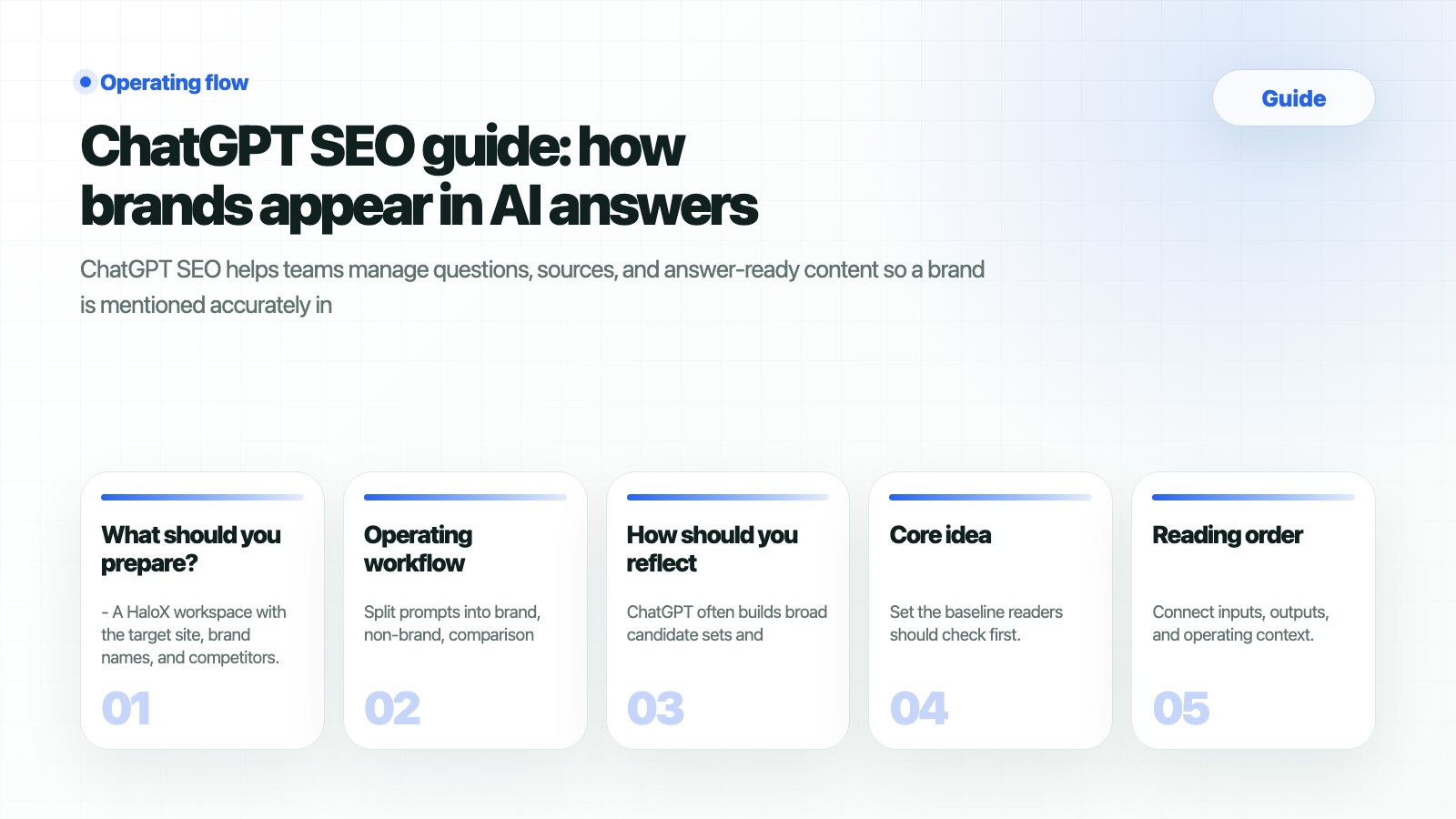 Use this workflow to turn AI-search monitoring into weekly execution. Start from the questions users ask, then connect answer evidence to HaloX reports.
## What should you prepare?
* A HaloX workspace with the target site, brand names, and competitors.
* Strategic questions from SEO research and sales calls. Add customer-support and product-positioning questions when they change buying intent.
* Public pages that can act as answer sources. Start with product pages and docs, then add FAQs, comparison pages, case studies, and press coverage.
* A place to record decisions, owners, and follow-up content tasks.
## How do you verify the result?
| Check | Healthy state | Next action |
| ----------------- | ------------------------------------------------------------------------------------ | -------------------------------- |
| Question coverage | Important brand
Use this workflow to turn AI-search monitoring into weekly execution. Start from the questions users ask, then connect answer evidence to HaloX reports.
## What should you prepare?
* A HaloX workspace with the target site, brand names, and competitors.
* Strategic questions from SEO research and sales calls. Add customer-support and product-positioning questions when they change buying intent.
* Public pages that can act as answer sources. Start with product pages and docs, then add FAQs, comparison pages, case studies, and press coverage.
* A place to record decisions, owners, and follow-up content tasks.
## How do you verify the result?
| Check | Healthy state | Next action |
| ----------------- | ------------------------------------------------------------------------------------ | -------------------------------- |
| Question coverage | Important brand
non-brand
comparison
and buying questions are tracked | Add missing prompts to HaloX |
| Source visibility | Official and third-party sources are mapped to answer opportunities | Strengthen weak pages or sources |
| Execution path | Monitoring output becomes content, technical, or reporting work | Assign owners and deadlines |
## What commonly blocks teams?
| Blocker | Cause | Fix |
| ----------------------------------------- | ---------------------------------------------------------------------------- | ------------------------------------------------------------------- |
| The answer is too generic | The public page does not contain a clear definition, comparison, or evidence | Add answer-ready blocks
tables
FAQs
and source links |
| Competitors appear but the brand does not | Non-brand and comparison questions are not covered | Build pages for problem, alternative, and buying-intent queries |
| Citations point to weak sources | Official pages are not structured as evidence | Improve headings
schema
freshness
and internal links |
## Operating workflow
Split prompts into brand and non-brand questions first. Keep comparison and buying-intent questions as separate sets.
Check brand mentions first. Then review competitor exposure, citations, source visibility, and answer accuracy.
Decide whether the gap is a missing official page or a weak source. If neither explains it, check technical and reporting issues.
Add definitions and comparison tables that AI systems can summarize reliably. Use FAQs, evidence, and links to support the answer.
Track AVI and citation rate each week. Use source visibility and question coverage to explain the movement.
## Related HaloX docs
* [GEO](/en/glossary/geo)
* [AI Visibility Index](/en/glossary/avi)
* [Citation rate](/en/glossary/citation-rate)
* [Content factory](/en/features/content-factory)
## How should you reflect engine-specific differences?
ChatGPT often builds broad candidate sets and explains recommendation logic. Strengthen entity hubs that connect brand definitions with alternatives, buying criteria, FAQs, and recent updates.
| Checkpoint | Question to ask | HaloX area |
| -------------------- | ------------------------------------------------------------------------------------------- | ------------------------------------ |
| Answer structure | Does the engine place the brand as a recommendation, comparison option, or official source? | Prompt Analysis, AVI |
| Source trust | Which owned or external source gets cited? | Citation Tracking, source visibility |
| Content format | Are definitions
comparison tables
FAQs
or checklists missing? | Content Factory |
| Technical foundation | Are crawlability
schema
SSR/CSR
or performance issues blocking reuse? | Site Audit |
### Meeting-ready explanation
“Engine-specific optimization is not a separate trick for every model. It turns the same brand facts into question and source structures that each engine can read. HaloX separates that work into prompt sets, citation rate, and source visibility.”