> ## Documentation Index
> Fetch the complete documentation index at: https://docs.haloxlabs.ai/llms.txt
> Use this file to discover all available pages before exploring further.
# Fan-out search patterns
> How to analyze AI search fan-out from root questions to source paths and citation actions in HaloX.
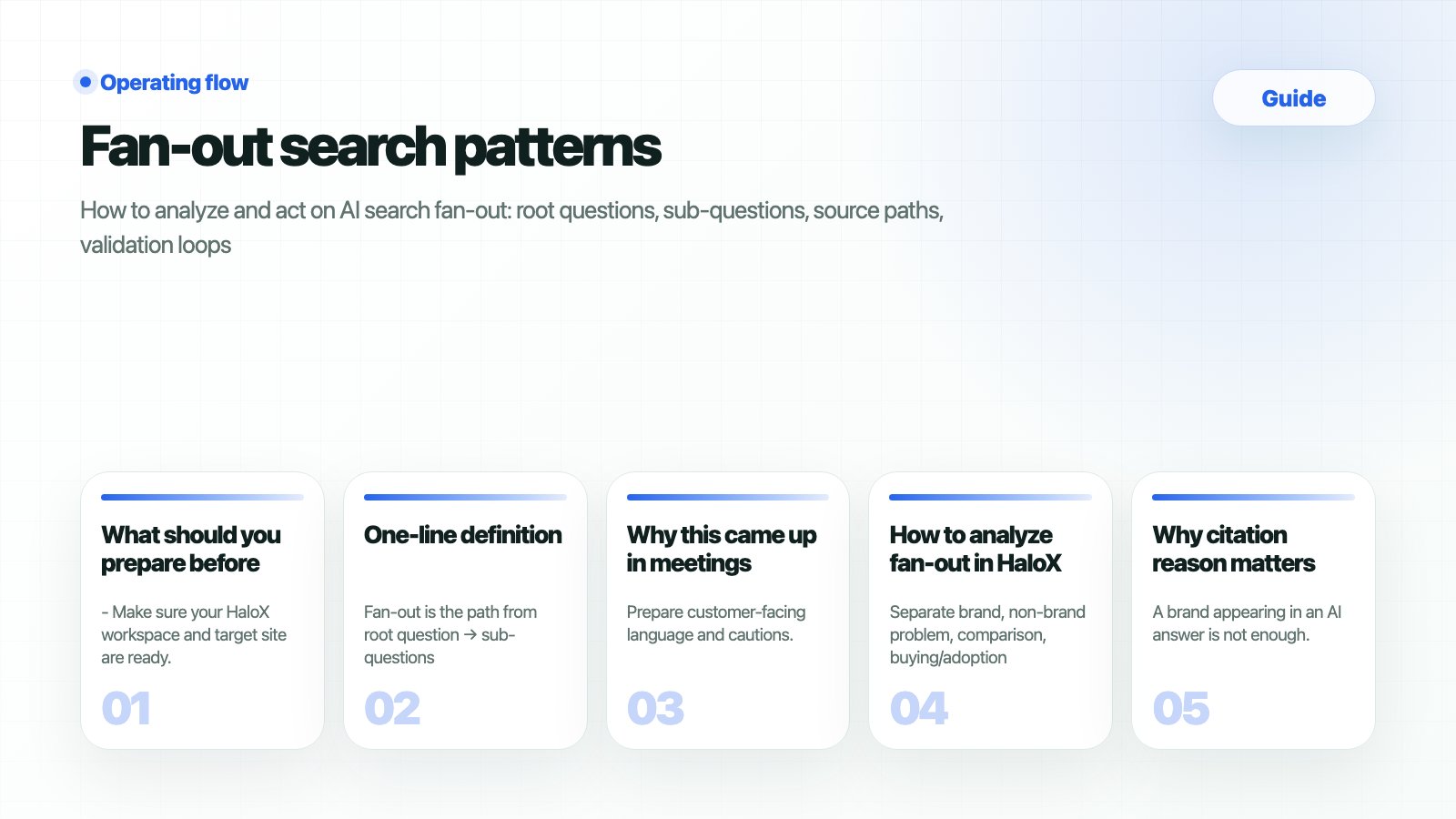 AI search engines do not answer a user question in one straight line. ChatGPT, Gemini, Perplexity and Claude often expand a question into sub-questions, comparison criteria and source checks. HaloX treats this as a **fan-out search pattern**.
For example, “Which GEO tool should our industry use?” can expand into:
* What GEO means
* Which use cases exist in this industry
* How GEO differs from SEO tools
* What to check before adoption
* Which sources and guides are trustworthy
GEO operations therefore cannot stop at the ranking of one representative keyword. You need to know **how a question fans out and whether your brand and content appear along each path**.
## What should you prepare before starting?
* Make sure your HaloX workspace and target site are ready.
* Keep GSC/GA4 access and any existing SEO or meeting notes nearby.
* Decide where the output will live: internal note, client report, or weekly operating document.
## How do you verify the result?
| Check | Healthy state | Next action |
| ------------------ | ----------------------------------------------------------- | ------------------------------------------------------- |
| Workflow completed | The requested audit or reporting task is finished | Reflect the result in Strategy Map and the right report |
| Priority selected | The next keyword, page, or content opportunity is clear | Assign an owner and due date |
| Evidence recorded | The metrics and reasoning can be reused in the next meeting | Track the same signals next week |
## What commonly blocks teams?
| Problem | Cause | Fix |
| --------------------------------------------- | ------------------------------------------------------------ | -------------------------------------------------------- |
| Scores are visible but next steps are unclear | Metrics were not translated into execution units | Start from Strategy Map GAP types and priority clusters. |
| It is hard to explain to customers | Technical signals were not converted into business language | Add cause, impact, and next action to every report item. |
| Results do not change immediately | AI answer surfaces need time to recrawl and reassess sources | Track the same prompt set and metrics weekly. |
## One-line definition
> Fan-out is the path from `root question → sub-questions → source candidates → validation loop → final answer/citation`.
| Stage | What AI systems do | What to do in HaloX |
| ----------------- | ----------------------------------------------------------------------------------------------------------------------------- | --------------------------------------------------------------------------------- |
| Root question | Interpret the original user question. | Add representative questions to a strategic prompt set. |
| Sub-questions | Split into definition
AI search engines do not answer a user question in one straight line. ChatGPT, Gemini, Perplexity and Claude often expand a question into sub-questions, comparison criteria and source checks. HaloX treats this as a **fan-out search pattern**.
For example, “Which GEO tool should our industry use?” can expand into:
* What GEO means
* Which use cases exist in this industry
* How GEO differs from SEO tools
* What to check before adoption
* Which sources and guides are trustworthy
GEO operations therefore cannot stop at the ranking of one representative keyword. You need to know **how a question fans out and whether your brand and content appear along each path**.
## What should you prepare before starting?
* Make sure your HaloX workspace and target site are ready.
* Keep GSC/GA4 access and any existing SEO or meeting notes nearby.
* Decide where the output will live: internal note, client report, or weekly operating document.
## How do you verify the result?
| Check | Healthy state | Next action |
| ------------------ | ----------------------------------------------------------- | ------------------------------------------------------- |
| Workflow completed | The requested audit or reporting task is finished | Reflect the result in Strategy Map and the right report |
| Priority selected | The next keyword, page, or content opportunity is clear | Assign an owner and due date |
| Evidence recorded | The metrics and reasoning can be reused in the next meeting | Track the same signals next week |
## What commonly blocks teams?
| Problem | Cause | Fix |
| --------------------------------------------- | ------------------------------------------------------------ | -------------------------------------------------------- |
| Scores are visible but next steps are unclear | Metrics were not translated into execution units | Start from Strategy Map GAP types and priority clusters. |
| It is hard to explain to customers | Technical signals were not converted into business language | Add cause, impact, and next action to every report item. |
| Results do not change immediately | AI answer surfaces need time to recrawl and reassess sources | Track the same prompt set and metrics weekly. |
## One-line definition
> Fan-out is the path from `root question → sub-questions → source candidates → validation loop → final answer/citation`.
| Stage | What AI systems do | What to do in HaloX |
| ----------------- | ----------------------------------------------------------------------------------------------------------------------------- | --------------------------------------------------------------------------------- |
| Root question | Interpret the original user question. | Add representative questions to a strategic prompt set. |
| Sub-questions | Split into definition
comparison
buying criteria
location
risk
and review questions. | Use Strategy Map to inspect clusters and gap types. |
| Source candidates | Look for evidence across official sites
newsrooms
blogs
reviews
video
communities
and articles. | Use Citation Tracking to separate Source from Citation. |
| Validation loop | Compare consistency
authority
freshness
and structure across sources. | Use Site Audit and Content Factory trust reports. |
| Answer/citation | Mention a brand or cite a link in the final answer. | Track citation rate, question share, and repeated competitor exposure in reports. |
## Why this came up in meetings
Customer and partner meetings kept repeating the same point: a single brand page is not enough. You need to follow the sub-questions and source paths that AI systems use.
| Meeting requirement | Fan-out interpretation | Connected HaloX features |
| -------------------------------------------------------------------------------------------------------------- | ----------------------------------------------------------------------------------------------------------------------------------- | ---------------------------------------------- |
| Financial/platform teams want non-brand conversion questions, brand search and non-brand conversion questions. | “Before signing up,” “comparison,” “how to,” and “best” questions fan out from the root intent. | Prompt Analysis, Strategy Map, Content Factory |
| Enterprise communications teams want leadership
issue
newsroom
and owned-media monitoring. | Brand-definition questions fan out into leadership
issues
owned media
and external articles. | Citation Tracking, Site Audit, Weekly Reports |
| PR/brand teams ask about Naver, Google, and AI-channel differences. | The same question can lead to Naver blogs
newsrooms
YouTube
articles
LinkedIn
and other sources. | Citation Tracking, Agency GEO operations |
| B2B SaaS teams ask about GEO after SEO drops. | Recover the core search topic first
then expand into problem
comparison
and adoption questions. | Site Audit, Strategy Map, Content Factory |
| Local businesses ask about local GEO. | Questions split into “location + recommendation,” service comparison
before-visit questions
and English/global questions. | Local GEO guide, Prompt Analysis |
## How to analyze fan-out in HaloX
Separate brand questions from non-brand, comparison, buying and location questions. Explain prompts as “core questions AI receives.”
Fan-out questions usually spread across several keyword clusters. Review search demand, AIO/GEO/SEO state, gap type and urgency together.
Separate whether your brand is only mentioned, used as a source candidate, or explicitly cited as a link. Repeated competitor citations are high-priority content gaps.
Even good content may fail when robots rules, CDN behavior, schema gaps or JavaScript dependence block discovery.
Build definitions, comparison tables, FAQ pages and evidence blocks with internal links.
## Example fan-out prompt sets
| Industry / objective | Root question | Fan-out sub-questions | Needed content |
| -------------------- | ------------------------------------ | ----------------------------------------------------------------------------------------------------------- | ----------------------------------------------------------------------------- |
| Financial platform | “Best crypto exchange” | How to trade
fee comparison
security
before-signup checks
app usability | Comparison page
beginner guide
FAQ
security/policy page |
| B2B SaaS | “Best CRM marketing automation tool” | Definition
adoption criteria
alternatives
case studies
pricing/operations | Problem guide
comparison content
checklist
case page |
| PR/brand | “What kind of company is this?” | Leadership
issues
business structure
official newsroom
external articles | Fact sheet
newsroom hub
FAQ
issue explainer |
| Local business | “Best clinic in Gangnam” | Location
service criteria
before-visit questions
reviews/trust
foreign-language support | Branch landing page
local FAQ
service comparison
English guide |
| Agency proposal | “How do you diagnose GEO?” | Diagnosis items
score interpretation
execution priority
report outputs | One-page diagnosis, operating loop, report sample |
## Why citation reason matters
A brand appearing in an AI answer is not enough. The role inside the answer matters.
| State | Plain-language explanation | Next action |
| ------------------- | ----------------------------------------------------------------------- | ---------------------------------------------------------------------------- |
| Mention | “The name appears, but we do not know whether it was used as evidence.” | Check brand accuracy and competitor co-mentions. |
| Source | “The page became an evidence candidate.” | Strengthen structure
references
freshness
and internal links. |
| Citation | “The page appeared as a cited link/source.” | Track whether it repeats across the same question group. |
| Competitor citation | “A competitor was selected as evidence.” | Compare their page format with your content gap. |
| No reliable source | “AI relies on generic summaries instead of official evidence.” | Add FAQ
fact sheets
entity hubs
schema
and bot access. |
## Convert questions into content
| Content element | Why it matters | Example |
| -------------------------- | ------------------------------------------------- | ----------------------------------------------------------------------------------------------- |
| First-paragraph definition | Gives AI a clear answer sentence. | “GEO is an operating method for managing brand mentions, sources, and citations in AI answers.” |
| Question-led H2/H3 | Matches the sub-query shape. | “Why is my AI citation rate low?” |
| Comparison table | Supports recommendation and comparison questions. | Criteria table across options. |
| FAQ | Captures real customer objections. | “Should we do GEO before SEO is fixed?” |
| Evidence/source links | Increases citation readiness. | Official docs
newsroom
data
policy
examples. |
| Internal links | Connects the fan-out path. | Definition → comparison → playbook → report. |
## Talk track for customers
> “AI does not answer a question as a single keyword lookup. It expands the question into related sub-questions and source checks. HaloX therefore monitors prompt sets, source paths, citations and content actions as one operating loop.”
## Related docs
* [Customer-meeting GEO scenarios](/en/guides/customer-meeting-scenarios)
* [Prompt Analysis](/en/features/prompt-analysis)
* [Strategy Map](/en/features/strategy-map)
* [Citation Tracking](/en/features/citation-tracking)
* [Content Factory](/en/features/content-factory)
* [PR and brand AI citations](/en/guides/pr-brand-ai-citations)
* [B2B SaaS GEO operations](/en/guides/b2b-saas-geo)