> ## Documentation Index
> Fetch the complete documentation index at: https://docs.haloxlabs.ai/llms.txt
> Use this file to discover all available pages before exploring further.
# Naver AI search optimization for Korean GEO
> Plan Korean AI search optimization for Naver, Cue, blogs, news, and Korean-language source visibility using HaloX GEO workflows.
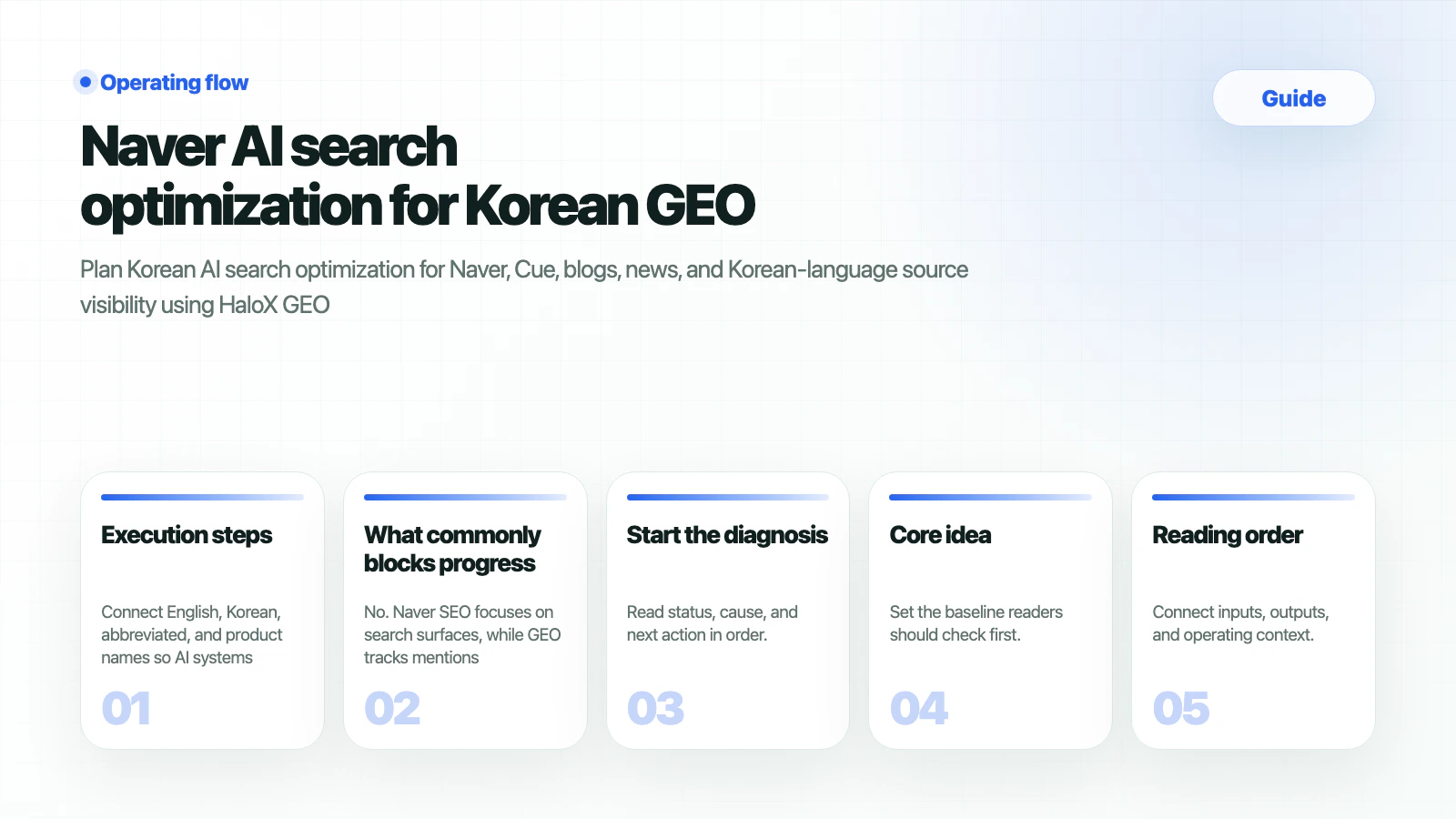 Korean AI search optimization should not be limited to ChatGPT or Google AI Overview. Naver search, blogs, news, Knowledge iN, places, communities, and Korean-language media can all become source candidates for AI answers.
Use this guide for intents such as “Naver AI search optimization,” “Cue AI search optimization,” “Korean AI search optimization,” and “AI search PR in Korea.”
## What should you prepare
| Input | Why it matters |
| ----------------------- | ----------------------------------------------------------------- |
| Korean brand variants | Connect English names, Korean names, and product names. |
| Naver source candidates | Blog
Korean AI search optimization should not be limited to ChatGPT or Google AI Overview. Naver search, blogs, news, Knowledge iN, places, communities, and Korean-language media can all become source candidates for AI answers.
Use this guide for intents such as “Naver AI search optimization,” “Cue AI search optimization,” “Korean AI search optimization,” and “AI search PR in Korea.”
## What should you prepare
| Input | Why it matters |
| ----------------------- | ----------------------------------------------------------------- |
| Korean brand variants | Connect English names, Korean names, and product names. |
| Naver source candidates | Blog
news
Knowledge iN
Places
official pages. |
| Korean prompt set | Recommendation
comparison
review
local prompts. |
| Official source page | Gives AI and search engines a canonical reference. |
## Execution steps
Connect English, Korean, abbreviated, and product names so AI systems can understand they refer to the same entity.
Map official pages, blogs, news, communities, reviews, and local listings to prompt types.
Use [Prompt Analysis](/en/features/prompt-analysis) and [Citation Tracking](/en/features/citation-tracking) to monitor Korean-language answers and sources.
Strengthen newsroom, comparison, FAQ, customer story, and offsite sources for Korean AI answers.
## How do you verify
| Signal | How to check |
| ----------------- | -------------------------------------------------------------------------- |
| Brand variants | English and Korean names map to the same entity. |
| Source diversity | Naver
media
blog
and official sources appear as candidates. |
| Question coverage | Korean recommendation and comparison prompts are covered. |
| Weekly reporting | PR, content, and technical tasks are separated. |
## What commonly blocks progress
No. Naver SEO focuses on search surfaces, while GEO tracks mentions, sources, and citations inside AI answers. They still share Korean source signals.
Quality and entity consistency matter more than volume. Blog, news, and official pages should point to the same brand meaning.
Yes. Korean-first pages support local intent, while English pages help global AI engines keep the same brand meaning.
## Start the diagnosis
Move the brand name, primary URL, competitors, and problem prompts from this guide into the HaloX app. Docs explain the decision criteria; the app shows the live scores, evidence, and report workflow.
Enter the primary URL and target prompts to create the first AI visibility baseline.
New teams should confirm the workspace, site diagnosis, and first report sentence.
Connect AI visibility diagnosis, ChatGPT brand mention checks, and Perplexity source checks to lead capture.
Choose the first 30-day operating scope for internal, agency, PR, B2B, or local-brand teams.
## Related docs
* [PR and brand AI citation playbook](/en/guides/pr-brand-ai-citations)
* [Local GEO operations](/en/guides/local-geo-operations)
* [Entity Hub](/en/glossary/entity-hub)