> ## Documentation Index
> Fetch the complete documentation index at: https://docs.haloxlabs.ai/llms.txt
> Use this file to discover all available pages before exploring further.
# Source trust checklist: organize AI citation candidates
> Use HaloX Knowledge Hub, Prompt Analysis, and Site Audit to organize official and external sources that can become AI answer citations.
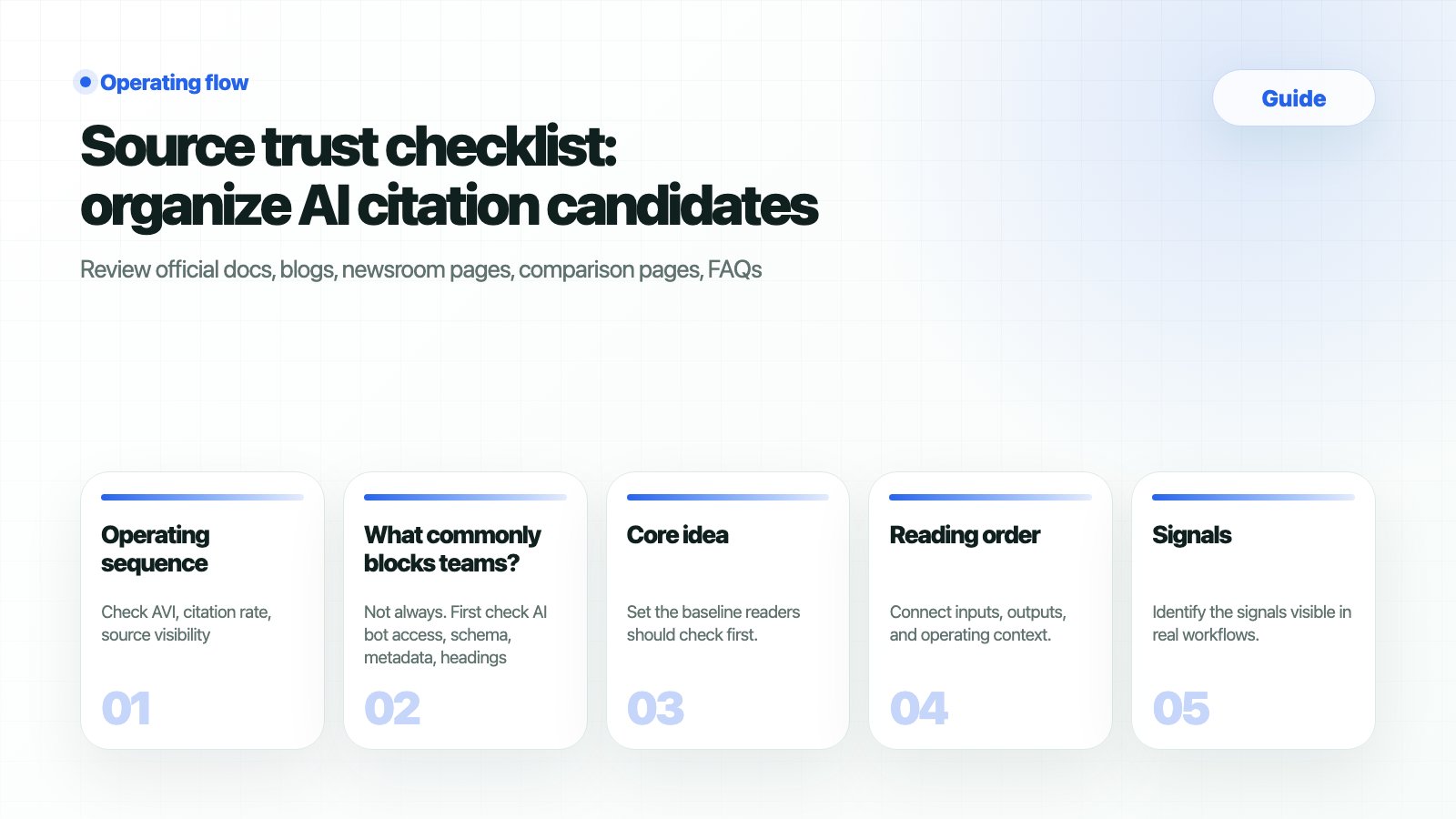 Source trust work is not “write more good content.” It is the job of classifying and improving the URLs an AI answer can select as evidence: official sources, external sources, technical accessibility, and content structure.
## What should you prepare
| Input | Where to open it in HaloX | Ready state |
| ----------------------- | ---------------------------------- | ----------------------------------------------------------------------------------- |
| Official sources | Knowledge Hub, Content Production | Product docs
Source trust work is not “write more good content.” It is the job of classifying and improving the URLs an AI answer can select as evidence: official sources, external sources, technical accessibility, and content structure.
## What should you prepare
| Input | Where to open it in HaloX | Ready state |
| ----------------------- | ---------------------------------- | ----------------------------------------------------------------------------------- |
| Official sources | Knowledge Hub, Content Production | Product docs
FAQ
pricing
cases
and newsroom URLs are separated. |
| External sources | Prompt Analysis, Citation Tracking | Press
review
partner
and community URLs are tracked separately. |
| Technical accessibility | Site Audit | Robots
schema
titles
meta
and page status have been checked. |
| Question-source mapping | Prompt Analysis | Expected sources and actual citations can be compared per question. |
| Owner | Content Production, Weekly Reports | The page to improve and the owner are assigned. |
## When should you use this guide?
| Situation | Signal to inspect | Decision |
| --------------------------------------------- | ------------------------------------------------ | ---------------------------------------------------------------------- |
| The brand is mentioned but citations are weak | Prompt Analysis cites third-party sources | Improve official sources through Knowledge Hub and Content Production. |
| Competitor sources repeat | Comparison questions cite competitor pages first | Add comparison pages, FAQs, and cases. |
| AI Overview needs source readiness | Official pages are not used as evidence | Review Site Audit and schema/summary structure. |
| Client reporting needs evidence | Source quality must be explained clearly | Create good/watch/improve source tables. |
## Workflow
In the Pro sidebar analysis section, open Prompt Analysis and inspect answer text, brand mentions, and citation URLs per question.
Separate official docs, external reviews/press, competitor pages, and generic knowledge pages. The repeated type matters more than raw count.
Check whether candidate pages are crawlable and have titles, summaries, and schema that can work as answer evidence.
For questions missing official evidence, create briefs for FAQs, comparison tables, case pages, or definition pages.
In Weekly Report, list official source share, repeated competitor sources, and newly improved URLs separately from score movement.
## How do you verify the result?
| HaloX surface | Value to read | Next action |
| ------------------ | -------------------------------------------------- | ----------------------------------------- |
| Prompt Analysis | Citation URLs by question | Classify source types. |
| Citation Tracking | Official, external, and competitor source movement | Prioritize repeated citations. |
| Site Audit | Schema
meta
headings
bot access | Send technical issues to the right owner. |
| Content Production | Briefs for source improvements | Turn source gaps into pages. |
## Source trust classification
| Source type | Good state | Risk signal | HaloX follow-up |
| ----------- | ---------------------------------------------------------- | ---------------------------------------- | --------------------------------- |
| Official | Product
pricing
FAQ
or case pages are cited | Only old landing pages repeat | Knowledge Hub, Content Production |
| External | Press, reviews, and partner pages support the answer | Unofficial blogs explain product facts | PR or external page update |
| Competitor | Appears only in comparison context | Competitor URLs cite our brand questions | Comparison page and FAQ work |
| Technical | Schema and metadata explain the answer | Access is blocked or summaries are vague | Site Audit issue |
## What commonly blocks teams
No. GSC and GA4 describe search traffic and user behavior, while HaloX AVI, citation rate, and source visibility describe how the brand and sources appear in AI answers. They support the same operating decision but use different measurement units.
Keep baseline questions, but add separate sets when products, competitors, or buyer questions change. Do not overwrite the baseline; split the comparison axis so weekly reports can explain the cause of movement.
Move evidence into Weekly Report and Exports, and convert actions into Content Production briefs or Site Audit issues. In meetings, report the question group, source gap, and next action together, with the score.
## Related docs
Inspect citation URL movement.
Organize source candidates.
Check access and structured signals.
Turn source gaps into briefs.