> ## Documentation Index
> Fetch the complete documentation index at: https://docs.haloxlabs.ai/llms.txt
> Use this file to discover all available pages before exploring further.
# HaloX adoption planning and operating plans
> Use team type, operating goal, data readiness, and the first 30-day scope to decide where to start with HaloX.
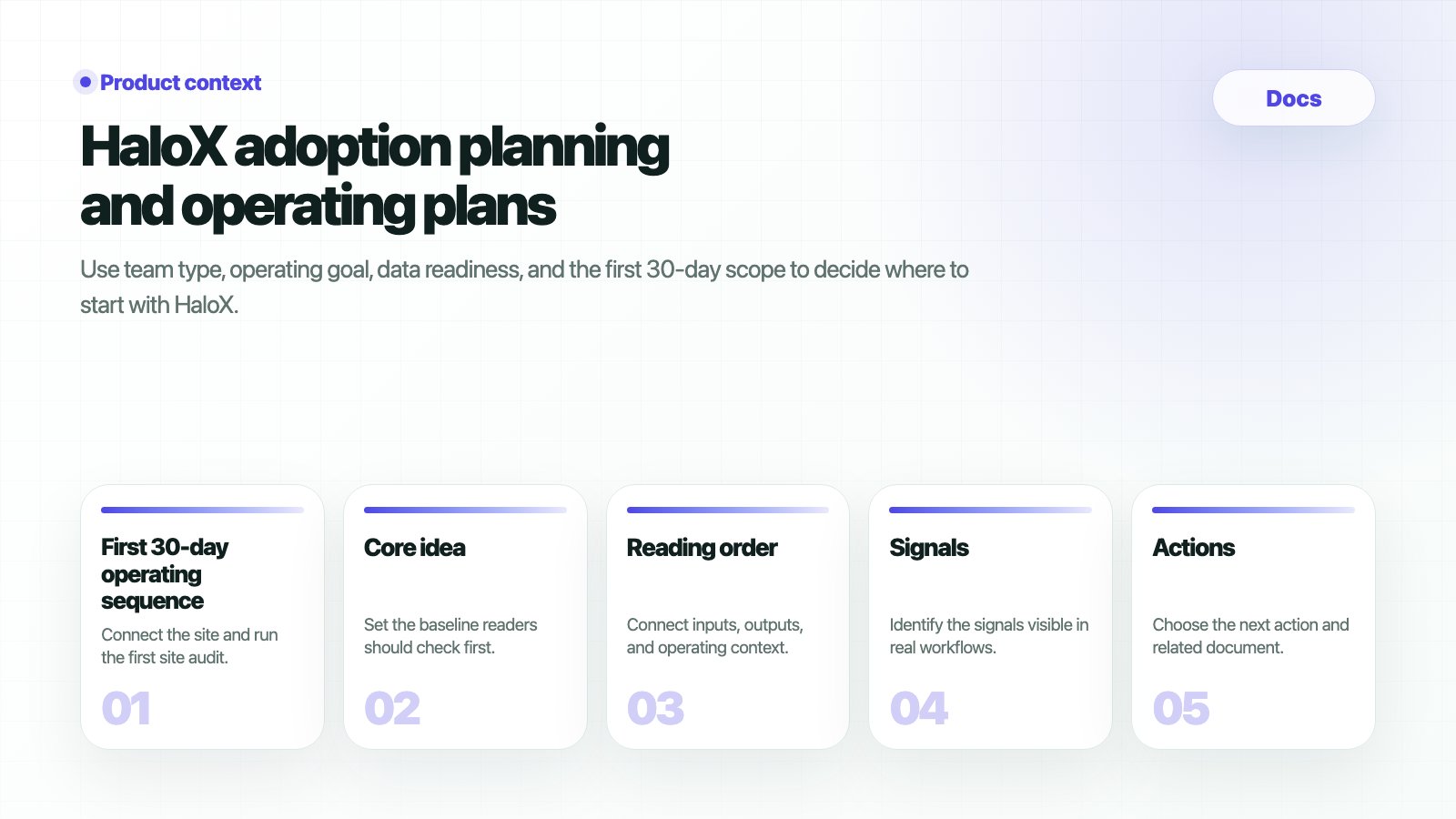 Before adopting HaloX, decide the **operating goal and the first 30-day scope**. AI search optimization is not a one-time report. It is a loop across diagnosis, measurement, strategy, execution, and reporting.
## Questions to answer first
| Question | Why it matters | Related doc |
| ------------------------------------------ | -------------------------------------------------------------------------------------- | ------------------------------------------------- |
| How many sites will you manage? | Site count changes diagnosis, reporting, and content priority. | [Quickstart](/en/introduction/quickstart) |
| Do you already use GSC or GA4? | Existing search and traffic signals improve interpretation. | [Connect GSC and GA4](/en/guides/connect-gsc-ga4) |
| Which questions should mention your brand? | Brand
Before adopting HaloX, decide the **operating goal and the first 30-day scope**. AI search optimization is not a one-time report. It is a loop across diagnosis, measurement, strategy, execution, and reporting.
## Questions to answer first
| Question | Why it matters | Related doc |
| ------------------------------------------ | -------------------------------------------------------------------------------------- | ------------------------------------------------- |
| How many sites will you manage? | Site count changes diagnosis, reporting, and content priority. | [Quickstart](/en/introduction/quickstart) |
| Do you already use GSC or GA4? | Existing search and traffic signals improve interpretation. | [Connect GSC and GA4](/en/guides/connect-gsc-ga4) |
| Which questions should mention your brand? | Brand
non-brand
comparison
and buying questions need different actions. | [Prompt analysis](/en/features/prompt-analysis) |
| Who receives the report? | Executives, clients, and SEO teams need different language. | [Weekly reports](/en/guides/reports) |
## Starting plans by team type
| Team type | First goal | Start with | First output |
| ----------------------------- | ----------------------------------------- | ----------------------------------------- | ------------------------------------ |
| In-house marketing or SEO | Find questions where the brand is missing | Dashboard, site audit, keyword clusters | AI search optimization checklist |
| PR or brand team | Understand how AI describes the brand | AVI, citation tracking, source visibility | Brand mention and source report |
| Agency | Package GEO as a client service | Meeting scenarios, weekly reports | Proposal and monthly operating loop |
| B2B SaaS | Appear in comparison and buying questions | Strategy map, content factory | Content brief, FAQ, comparison table |
| Local or multi-location brand | Manage local recommendation questions | Local GEO guide, site audit | Location question set |
## First 30-day operating sequence
Connect the site and run the first site audit. Check web health, AI bot access, schema, performance, metadata, and official pages that can be cited.
Separate brand, non-brand, comparison, buying, and local questions. Pick priorities in the strategy map.
Use Content Factory to create citation-ready structures with definitions, FAQs, comparison tables, evidence, and source links.
Summarize AVI, citation rate, source visibility, and question coverage changes, then assign the next operating actions.
## Adoption readiness checklist
| Item | Why it helps | If it is missing |
| -------------------------------- | --------------------------------------------------------- | ----------------------------------------------------------------- |
| Main site URL | Enables crawl, bot access, and schema diagnosis. | Start with the most important landing page. |
| Product description | Gives a reference for how AI should explain the brand. | Use the current website intro as a temporary baseline. |
| Main competitors or alternatives | Makes comparison questions measurable. | List three alternatives customers mention. |
| GSC or GA4 access | Connects GEO signals to existing search and traffic data. | Start with [data readiness](/en/guides/data-readiness-checklist). |
| Reporting audience | Shapes the depth and language of the report. | Begin with an internal operating summary. |
## Next docs
See what to check in the first 30 minutes.
Prepare access, sites, and question sets.
Review actions before and after adoption.
Turn GEO operations into proposal language.