
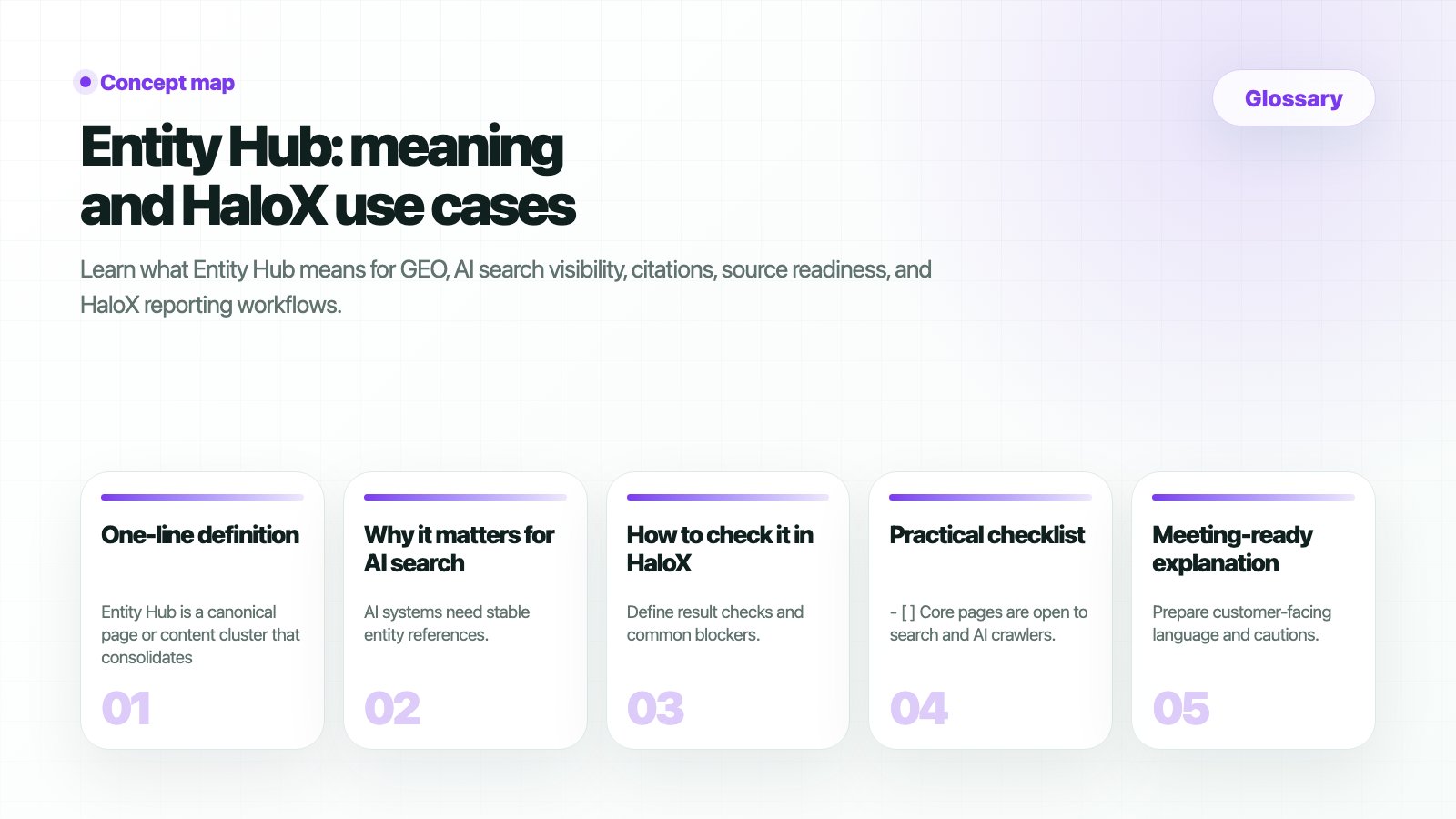
One-line definition
Entity Hub is a canonical page or content cluster that consolidates definitions, facts, FAQs, relationships, and trusted sources for a brand, product, person, place, or concept. In HaloX, an entity hub is useful because AI systems need one reliable place to understand what the entity is, what it does, and which sources support that understanding.Why it matters for AI search
AI systems need stable entity references. Without a clear hub, product facts, pricing context, comparisons, FAQs, and proof points can be scattered across many pages or external sources. An entity hub reduces ambiguity and gives teams a place to maintain the canonical version of the brand story.How to check it in HaloX
1
1. Check technical blockers in Site Audit
Review crawlability, rendering, metadata, schema, and page status before assuming content is the problem.
2
2. Connect it to strategic prompts
Measure the impact across branded, non-branded, comparison, and buying-review prompts.
3
3. Convert it into execution
Use FAQs, comparison tables, definition blocks, source links, JSON-LD, entity hubs, or topic clusters as concrete outputs.
Practical checklist
- Core pages are open to search and AI crawlers.
- Brand, product, category, location, author, and concept entities are clear.
- The page includes question-oriented headings, FAQs, comparisons, and definitions.
- Owned and external sources do not contradict each other.
- The content maps to Strategy Map priority clusters.
- Weekly reports can explain movement and next actions.
Common misunderstandings
Meeting-ready explanation
“Entity Hub helps AI systems read, understand, and use our brand information as reliable answer evidence.”
Related docs
Site Audit
Check technical foundation and AI access.
Content Factory
Create answer-ready content structure.
Strategy Map
Choose priority clusters.
GEO glossary
Browse related concepts.