
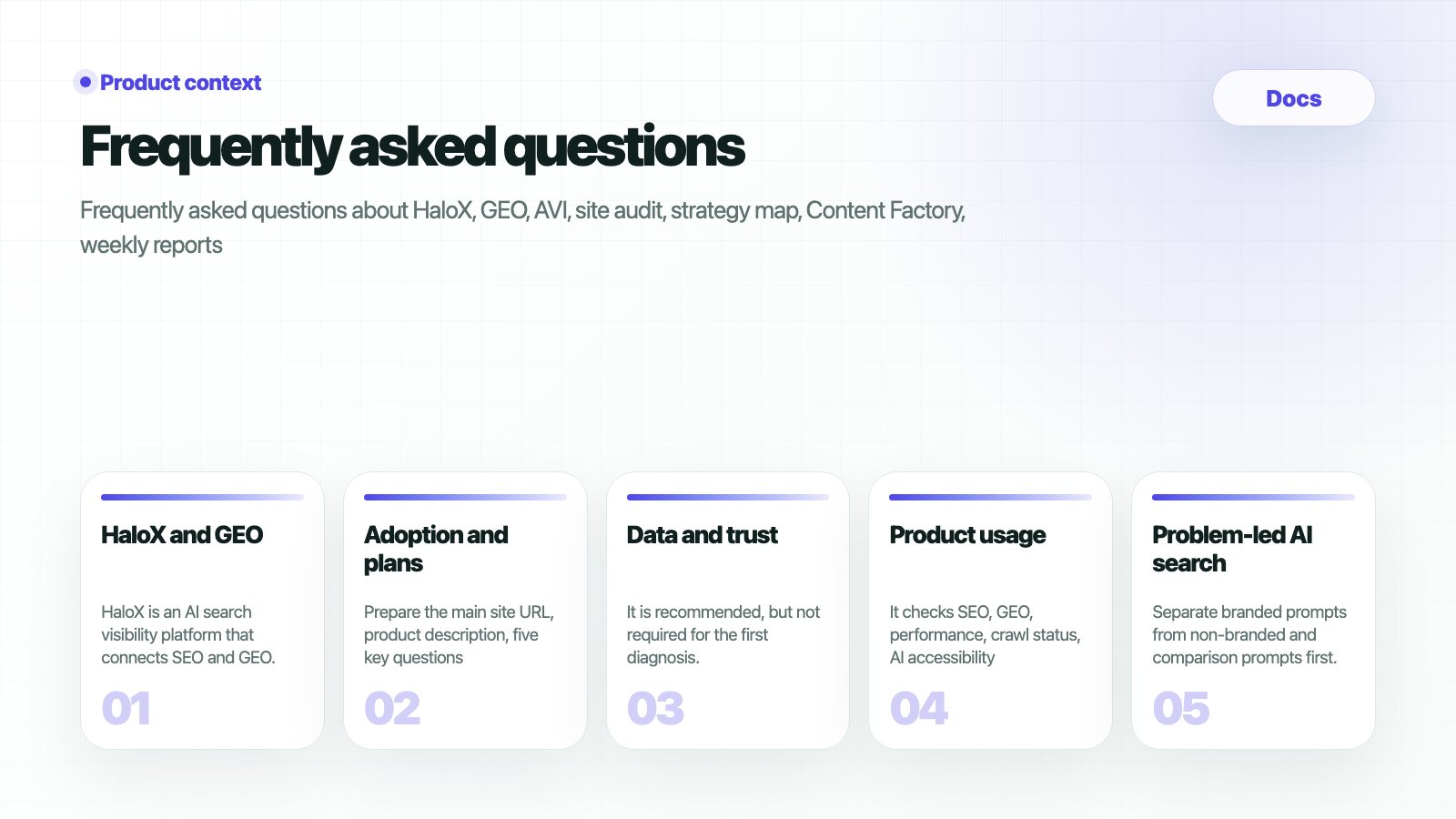
HaloX and GEO
What is HaloX?
What is HaloX?
HaloX is an AI search visibility platform for understanding how a brand appears in AI answers and which sources support it. Teams move from diagnosis to strategy, content work, and weekly reporting in one workflow.
Is GEO different from SEO?
Is GEO different from SEO?
GEO builds on SEO. SEO helps search engines crawl and understand a site; GEO manages how AI answers describe the brand and which evidence they use.
What should we do first?
What should we do first?
Start with overall AVI and web health on the Dashboard. Then review important Site Audit issues and choose the next GEO opportunity cluster in Strategy Map.
Adoption and plans
What should we prepare before adoption?
What should we prepare before adoption?
Prepare the main site URL and product description first. Key questions and competitors make the diagnosis stronger. GSC or GA4 access can be added after the first baseline.
Do we still need HaloX if we already use SEO tools?
Do we still need HaloX if we already use SEO tools?
Yes. Existing SEO tools show rankings and traffic. HaloX shows whether the brand appears in AI answers, whether official sources are cited, and which questions are missing coverage.
How should we measure success?
How should we measure success?
Early success starts with AVI and citation rate. Source visibility and question coverage should move before traffic and conversions become reliable indicators.
Can agencies use HaloX for client proposals?
Can agencies use HaloX for client proposals?
Yes. Use the client proposal template to scope the diagnosis and the GEO report example to package ongoing execution results.
Data and trust
Do we have to connect GSC or GA4?
Do we have to connect GSC or GA4?
It is recommended, but not required for the first diagnosis. Connecting search and traffic data improves interpretation of AI search signals.
How do we trust AI citations and sources?
How do we trust AI citations and sources?
Do not rely on one answer. Track repeated question sets and watch how official sources, citation URLs, and question coverage change together.
Does low AI traffic mean GEO is not useful?
Does low AI traffic mean GEO is not useful?
No. In GEO, brand mentions and citation rate can move before traffic. Treat traffic as a lagging indicator.
Product usage
What does site audit check?
What does site audit check?
It checks crawl status and AI accessibility first. Then it reviews structured data and JavaScript dependence before listing page-level issues.
When should we use the strategy map?
When should we use the strategy map?
Use it when deciding which keyword clusters and question groups to execute first. Search volume and gap type show where the next GEO opportunity sits.
How is Content Factory different from generic AI writing?
How is Content Factory different from generic AI writing?
Generic AI writing focuses on body generation. Content Factory connects strategy analysis, content drafting, and trust reporting to make content easier for AI systems to cite.
How should weekly reports be used?
How should weekly reports be used?
Use them for client and executive reporting. Summarize metric movement, open site issues, and the next content action.
Problem-led AI search
Where should we start if our brand is missing from AI search?
Where should we start if our brand is missing from AI search?
Separate branded prompts from non-branded prompts first. If the brand appears only when named directly, use Brand missing from AI search and Get mentioned in ChatGPT to review the missing question coverage.
What if AI answers mention only competitors?
What if AI answers mention only competitors?
Record the prompt groups and citation URLs that support competitors. Then use Competitor-only AI answers to break down Share of Voice, official-source gaps, and comparison content needs.
Can we create free AI visibility diagnosis lead assets?
Can we create free AI visibility diagnosis lead assets?
Yes. Keep the docs as the method explanation and route input/results UX to product or marketing pages. Use Free AI visibility diagnosis keyword strategy to design brand-mention and source-check paths.
Where do we start the actual diagnosis after reading the docs?
Where do we start the actual diagnosis after reading the docs?
The app entry is
https://haloxlabs.ai/app. Prepare the primary URL and brand name, then follow the Quickstart 30-minute flow to create the first baseline.