
What does it mean?
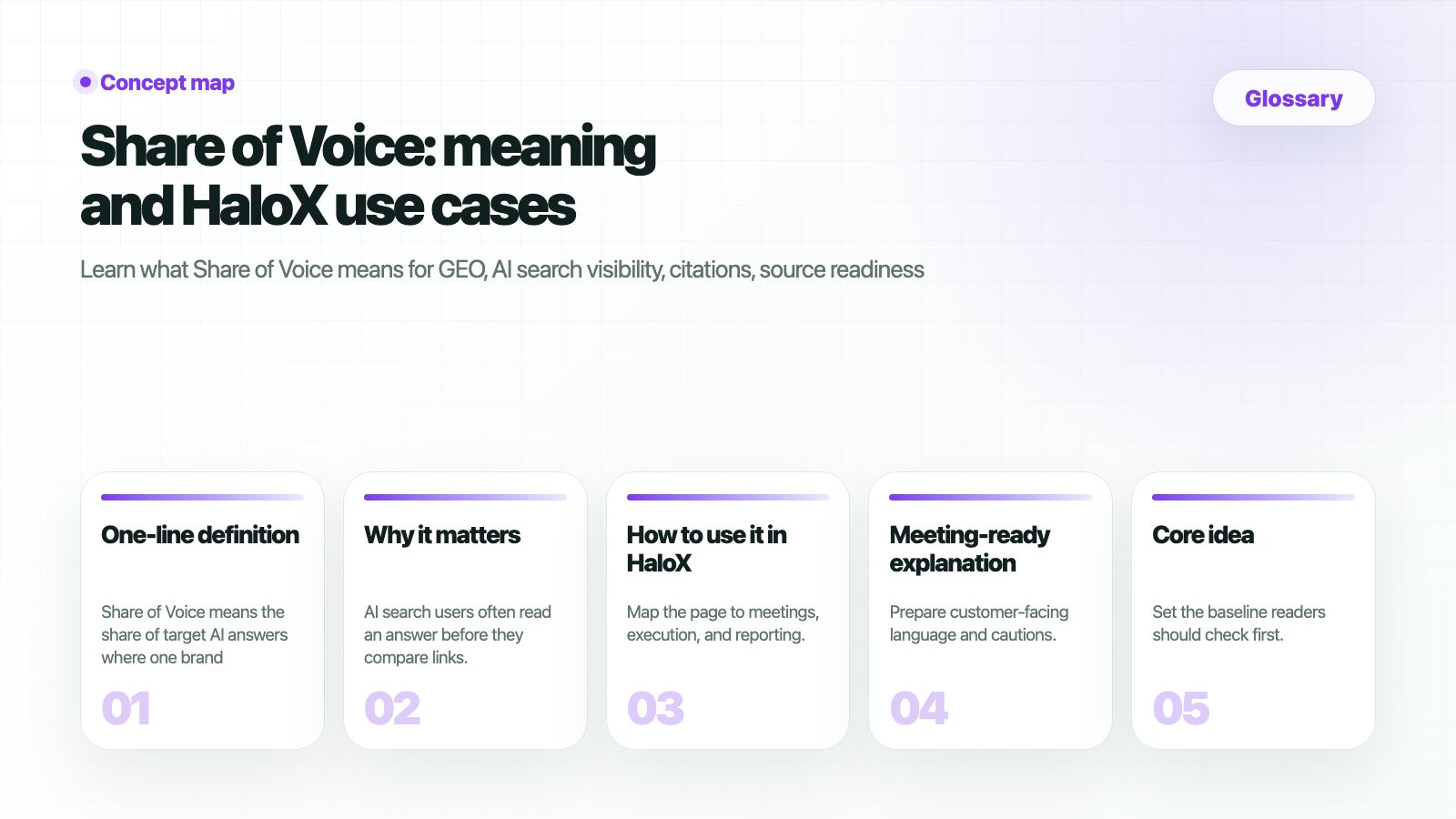
Source share, often shown as Share of Voice, compares how much of the AI answer source or citation space is owned by your brand versus competitors.How HaloX uses it
| HaloX view | What to check | Decision |
|---|---|---|
| Keyword Status / Analysis | Keyword-level search and AI signals | Separate ranking, AIO, and question-demand issues. |
| Prompt Status | M/S/C state by tracked question | Find whether the signal stops at mention, source, or citation. |
| Prompt Analysis | Coverage and competitor comparison by engine | Decide which prompt set or engine to fix first. |
| Citation Tracking | Source domains, URLs, counts, and share | Check which pages become AI-answer evidence. |
Decision examples
| State | Meaning | Next action |
|---|---|---|
| Mention exists but citation is missing | The brand appears, but source ownership is weak. | Strengthen answer-ready paragraphs, evidence links, and page structure. |
| Competitors own the source share | Competitors are selected as evidence more often. | Compare competitor cited pages with your missing source pages. |
| Coverage is low in one engine or prompt group | The average hides a specific gap. | Inspect the weak engine or question group separately. |
Related docs
Prompt Status
Check M/S/C status by question.
Prompt Analysis
Compare signals by prompt set and engine.
Citation Tracking
Review actual source domains and URLs.
HaloX service metrics glossary
Review all product metric definitions.
