
What is this feature?
Keyword Clusters is the feature for grouping related search intents and AI prompt contexts into execution units. It is a decision point in the HaloXdiagnose → measure → prioritize → execute → report loop. Teams use it to read the current signal, split the cause, and decide the next content, source, technical, or reporting action.
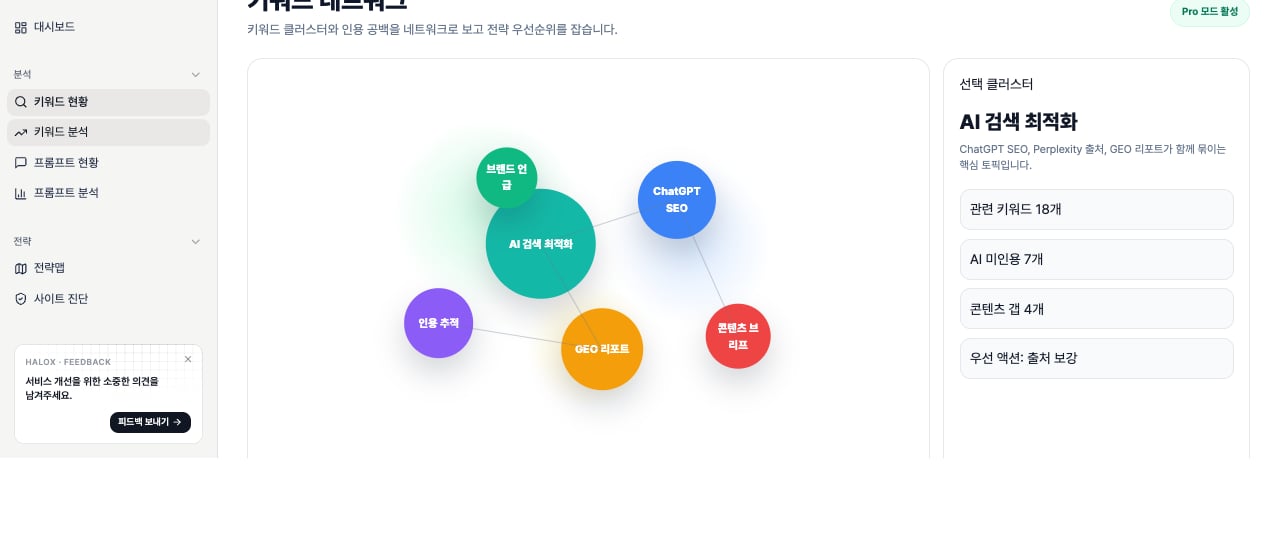
HaloX app location
Inputs and outputs
| Area | What it includes | Example |
|---|---|---|
| Inputs | Site brand strategic prompts clusters source candidates | Brand name non-branded prompts competitors owned URLs |
| Signals | Scores answers sources citations web health gap types | AVI citation rate source visibility urgency GEO opportunity |
| Outputs | Next priority and reporting sentence | Technical fix content brief source work weekly report note |
What should you look at first?
1. Summarize the state in one sentence
Replace “the score is low” with a cause-based sentence such as “official citations are weak for non-branded comparison prompts.”
2. Split the cause into four work types
Move technical blockers to Site Audit. Send question gaps to Prompt Analysis, source gaps to Citation Tracking, and content gaps to Content Factory.
Main cards, tabs, or metrics
| Area | What to inspect | Decision standard |
|---|---|---|
| Current signal | Score card answer source or page issue | Baseline and week-over-week movement |
| Gap | Weak prompt source content or competitor advantage | Why the team should act |
| Priority | Urgency GEO opportunity AIO fit SEO foundation | What should happen this week |
| Next action | Content technical source or report work | Whether it can have an owner and deadline |
Practical use cases
| Situation | What to do with this feature | Output |
|---|---|---|
| Before a customer meeting | Find weak prompt sets and source gaps. | One-page diagnostic summary |
| Internal execution meeting | Choose this week’s content, technical, or source tasks. | Ticket or content brief |
| Executive/customer reporting | Explain cause and next action, with the score. | Weekly report or export |
| SEO/GEO strategy | Read SEO foundation and AI answer signals together. | Strategy Map and keyword clusters |
How to explain it in meetings
“This feature shows how far the brand travels inside AI search answers and what content, source, or technical action should happen next.” Avoid customer names, real URLs, and internal KPIs in public documentation.FAQ
Does this feature complete the decision by itself?
No. HaloX features are connected. A signal in Keyword Clusters should move into Site Audit, Strategy Map, Content Factory, Citation Tracking, or weekly reporting.Do scores map directly to business results?
Most GEO metrics are leading indicators. Mentions and citations usually move first; traffic, branded search and conversion prompts are checked later.Related guides and concepts
Quickstart
Start the first 30-minute workflow.
Reading scores
Translate metrics into meeting language.
GEO glossary
Understand GEO, AVI, citation rate, and source visibility.
Reports
Turn movement into reporting language.
How to read cluster card metrics
| Metric | What it means | Basis | Next action |
|---|---|---|---|
| Keyword count | Number of keywords in the cluster | Member count | If high, plan Pillar and Support content instead of one article. |
| Volume sum | Combined search demand across cluster keywords | Volume sum | High-demand clusters deserve priority review. |
| Opportunity Score | Summary score for execution opportunity | Cluster opportunity score | High score plus high gap makes it a content candidate. |
| Gap type | SEO/GEO state combination | CRITICAL, GEO_GAP, SEO_GAP, or FORTRESS | Decides which channel to improve first. |
| Brand and competitor GEO citation rate | How often the brand or competitors are cited in AI answers | Cluster GEO citation percentages | If competitor share is high, compare source pages first. |
Pillar vs Support
| Role | Meaning | When to use it |
|---|---|---|
| Primary keyword | Keyword that represents the cluster | Represents the main intent and demand. |
| Pillar | Main content page for the cluster | Covers the broad topic and central intent. |
| Support | Supporting content around the Pillar | Handles FAQ, comparison, how-to, and detailed questions. |
| Existing Jobs | Content Factory jobs already linked to the cluster | Avoid duplicates and continue from current progress. |
Example decisions
| Situation | Interpretation | Next action |
|---|---|---|
| Volume is high, but GEO citation is low | Demand exists, but AI answers do not cite the brand | Strengthen the Pillar content and official evidence pages. |
| Many keywords and many support candidates | The cluster needs a content set, not one page | Send one Pillar and several Support jobs to Content Factory. |
| FORTRESS cluster | SEO and GEO are both strong | Keep it in monitoring and competitor tracking. |
If you need the service metric definitions
Terms such asrank, search volume, trend, AI, PAA, Citation Rate, Share of Voice, and gap type are explained in the screen metrics glossary. Use it when a KPI on this page needs a plain-language definition and a link back to the screen where it appears.