
Documentation Index
Fetch the complete documentation index at: https://docs.haloxlabs.ai/llms.txt
Use this file to discover all available pages before exploring further.

What should you prepare
| Item | What to check | Where it connects in HaloX |
|---|---|---|
| Main URL | Site, landing page, blog, or docs URL to analyze | Site audit |
| Question set | Brand, non-brand, comparison, and buying questions | Prompt analysis |
| Baseline metrics | AVI, citation rate, source visibility, question coverage | AI Visibility Index |
| Owners | Technical owner, content owner, reporting owner | Weekly reports |
When should you use this guide?
| Situation | Decision point | Next action |
|---|---|---|
| First adoption | There is no baseline yet | Record the current state and create the first question set. |
| Score decline | AVI or citation rate falls | Separate question, source, and site causes. |
| Client reporting | The team needs cause and next action language | Convert findings into report sentences and tables. |
| Content execution | The team needs to decide what to publish | Create a content brief and source inventory. |
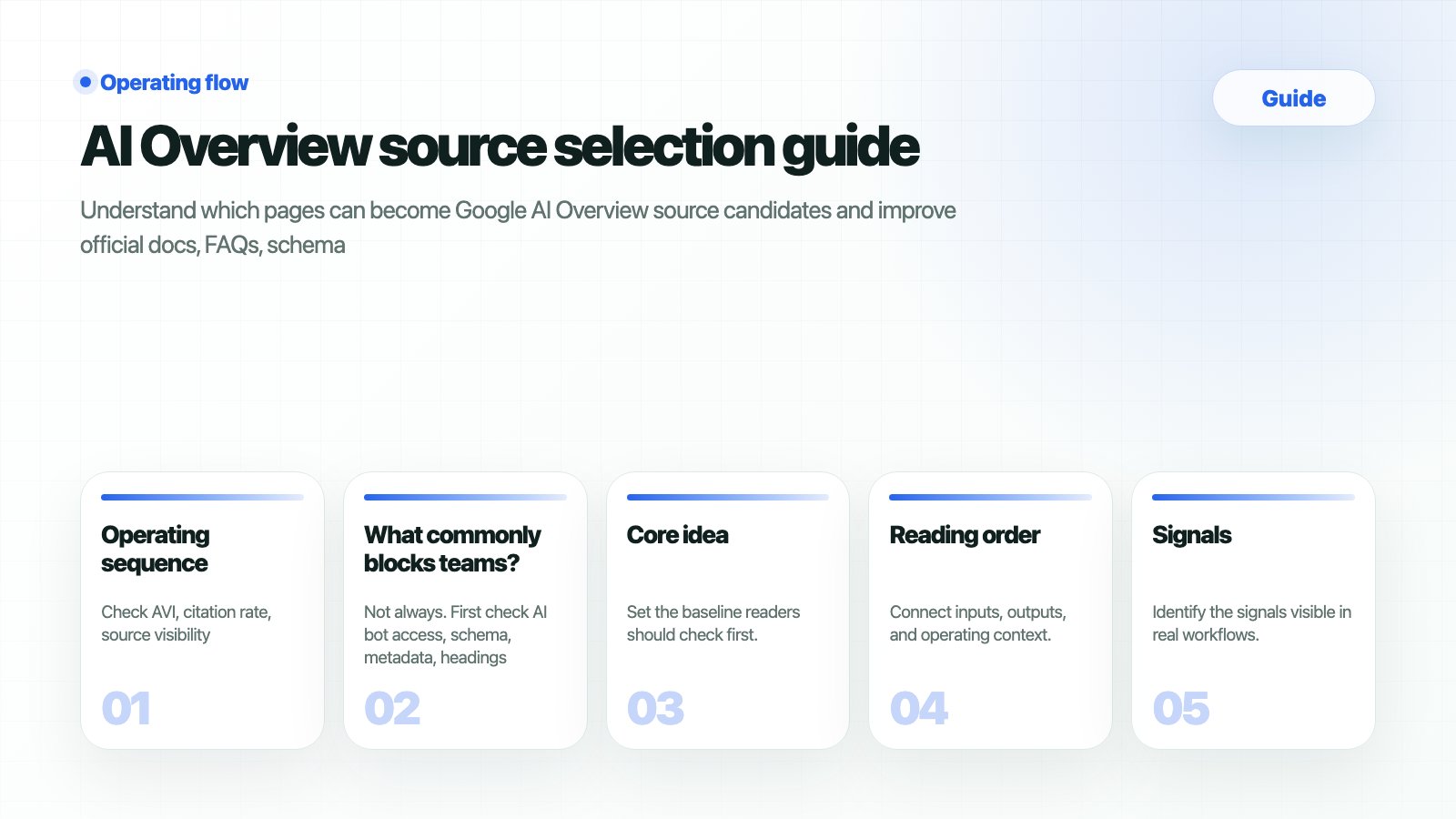
Operating sequence
1. Record the current baseline
Check AVI, citation rate, source visibility, and web health in the dashboard. Record which questions generated the signal, not only the number.
2. Segment questions by intent
Separate brand, non-brand, comparison, buying, and local questions. Mixed question sets make root causes harder to explain.
3. Organize source candidates
Separate official docs, blog posts, newsroom pages, help articles, comparison pages, external reviews, and media URLs.
4. Convert findings into actions
Technical blockers become engineering tasks, question coverage gaps become content briefs, and missing official sources become docs or FAQ improvements.
How do you verify the result?
| Signal | Healthy state | Watch out |
|---|---|---|
| AVI | The brand is consistently mentioned in priority questions. | The brand appears only in a narrow question group. |
| Citation rate | Official or trusted external URLs appear as citations. | The brand is mentioned but citations favor competitors or third parties. |
| Source visibility | Official docs, blog, FAQ, and newsroom assets become source candidates. | Old or unofficial URLs repeat as evidence. |
| Question coverage | Brand, non-brand, and comparison questions are tracked together. | Too few questions make changes hard to explain. |
What commonly blocks teams?
Should we create more content immediately when scores are low?
Not always. First check AI bot access, schema, metadata, headings, and performance in site audit. Content work is weaker if the technical foundation is blocked.
Can we judge GEO from one AI answer?
No. GEO should use repeated question sets over time. Compare mentions, citations, and sources across the same questions.
How should this be explained to clients?
Explain that the goal is not one score. The goal is to separate question coverage, source candidates, and citation rate, then assign the next action.
AI Overview source selection operating table
| Item | Value to record | Report sentence example |
|---|---|---|
| Baseline questions | Questions tracked this week | “This report reviews 15 brand, comparison, and buying questions.” |
| Issue found | Missing question group, weak source, or technical blocker | “The brand is mentioned in comparison questions, but official citations are weak.” |
| Execution action | Content, technical, or source improvement | “We will strengthen FAQ and comparison pages and re-check GSC access.” |
| Next check | Re-measurement date and owner | “The same question set will be re-measured in the next weekly report.” |
Related docs
Adoption planning
Choose team scope and first 30-day operations.
Reading scores
Translate AVI, citation rate, and source visibility into meeting language.
Content brief template
Turn findings into content execution structure.
GEO report example
Turn findings into client and executive reporting.
