

What should you prepare before starting?
- Make sure your HaloX workspace and target site are ready.
- Keep GSC/GA4 access and any existing SEO or meeting notes nearby.
- Decide where the output will live: internal note, client report, or weekly operating document.
How do you verify the result?
| Check | Healthy state | Next action |
|---|---|---|
| Workflow completed | The requested audit or reporting task is finished | Reflect the result in Strategy Map and the right report |
| Priority selected | The next keyword, page, or content opportunity is clear | Assign an owner and due date |
| Evidence recorded | The metrics and reasoning can be reused in the next meeting | Track the same signals next week |
What commonly blocks teams?
| Problem | Cause | Fix |
|---|---|---|
| Scores are visible but next steps are unclear | Metrics were not translated into execution units | Start from Strategy Map GAP types and priority clusters. |
| It is hard to explain to customers | Technical signals were not converted into business language | Add cause, impact, and next action to every report item. |
| Results do not change immediately | AI answer surfaces need time to recrawl and reassess sources | Track the same prompt set and metrics weekly. |
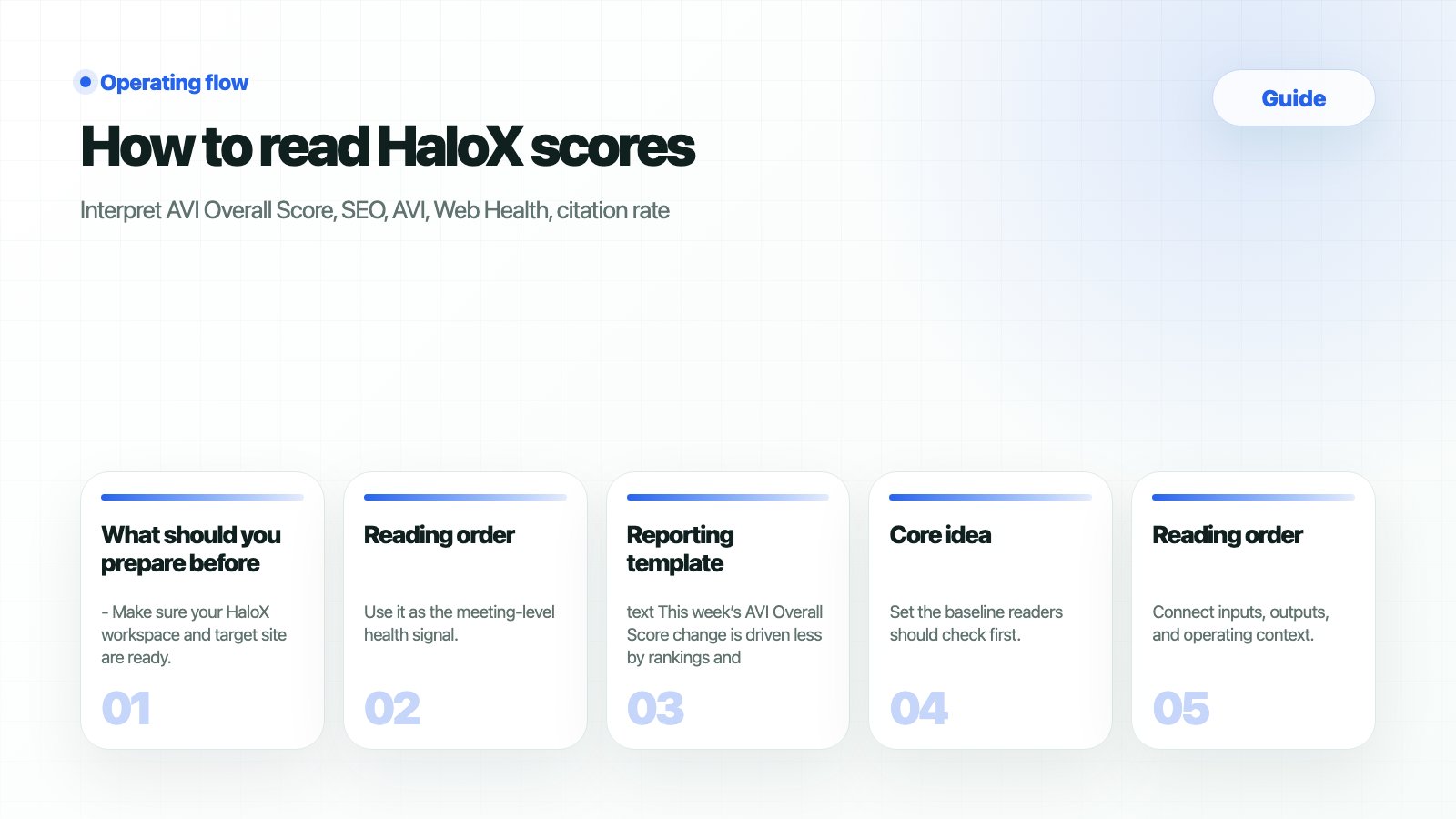
Reading order
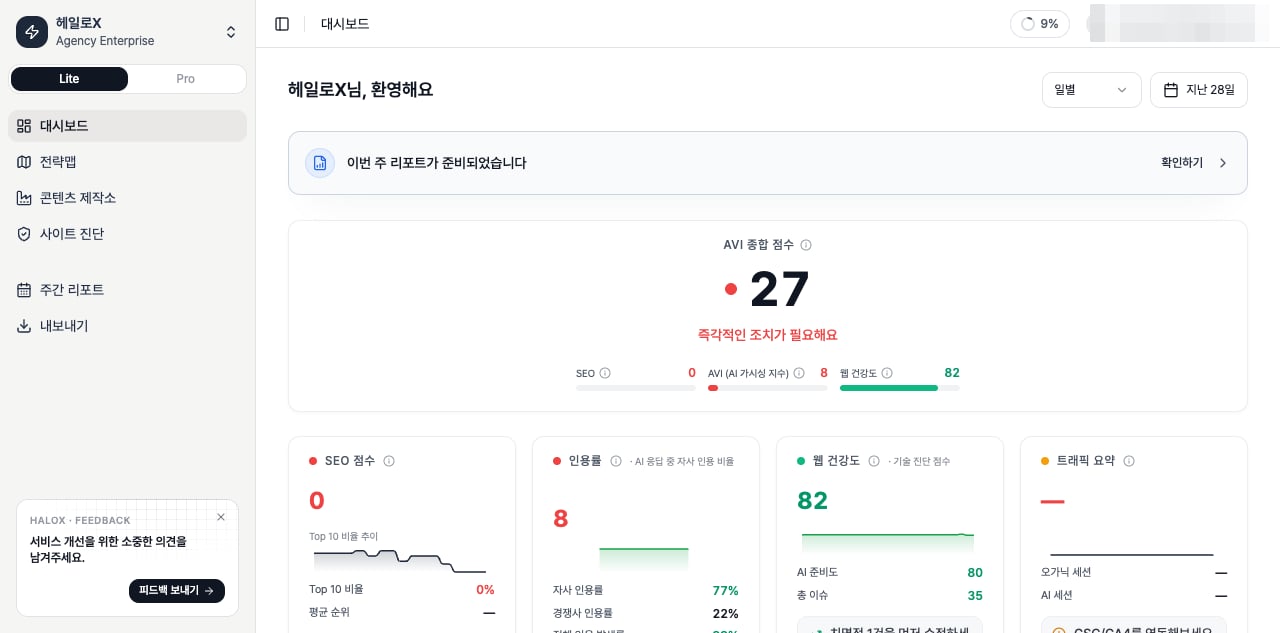
1. Start with AVI Overall Score
Use it as the meeting-level health signal. The number matters less than the weakest sub-metric behind it.
2. Separate SEO and Web Health issues
Decide whether the foundation is traditional search readiness, technical readability, or content structure.
3. Read AVI and citation rate together
Check whether the brand is mentioned, whether your own assets are used as sources, and whether competitors are taking the cited positions.
| App metric | Question it answers | If it is low |
|---|---|---|
| AVI Overall Score | Is the overall search/AI visibility healthy? | Open the weakest sub-metric |
| SEO | Is the traditional search foundation strong? | Run Site Audit and inspect metadata/schema/rankings |
| AVI | Does the brand appear in AI answers? | Check prompt sets and citation tracking |
| Web Health | Can AI and search engines read the site? | Fix performance accessibility JS dependency schema |
| Citation rate | Are your sources cited in AI answers? | Strengthen content structure and source signals |
| Traffic summary | Are search and AI signals turning into visits? | Check GSC/GA4 connections and reports |
Common interpretation patterns
High SEO, low citation rate
Pages may rank, but AI systems do not have clean definitions, tables, FAQs, or cited evidence to reuse. Rewrite the page into a citation-ready structure.
Low Web Health
Fix technical readability before producing more content. Rendering, schema, accessibility, and performance can block AI crawlers.
Low AVI, acceptable SEO
The site may be indexed, but key AI-answer questions are not covered. Rebuild prompt sets and keyword clusters.
High citation rate, low traffic
Source visibility may be improving before clicks follow. Report citation, source share, brand mentions, and prompt coverage together.
Meeting-language FAQ
| Question | Answer |
|---|---|
| “Does a low score mean low rankings?” | Not necessarily. HaloX combines search readiness AI-answer visibility source usage citation signals and technical readability. |
| “What score is good enough?” | The trend and bottleneck matter more than a fixed universal threshold. The right benchmark depends on industry and prompt set. |
| “Will publishing more content fix it?” | Only if the bottleneck is content coverage or citation structure. If Web Health is weak, technical fixes come first. |
| “What should executives see?” | AVI Overall Score week-over-week change top risk and three next actions. |
