
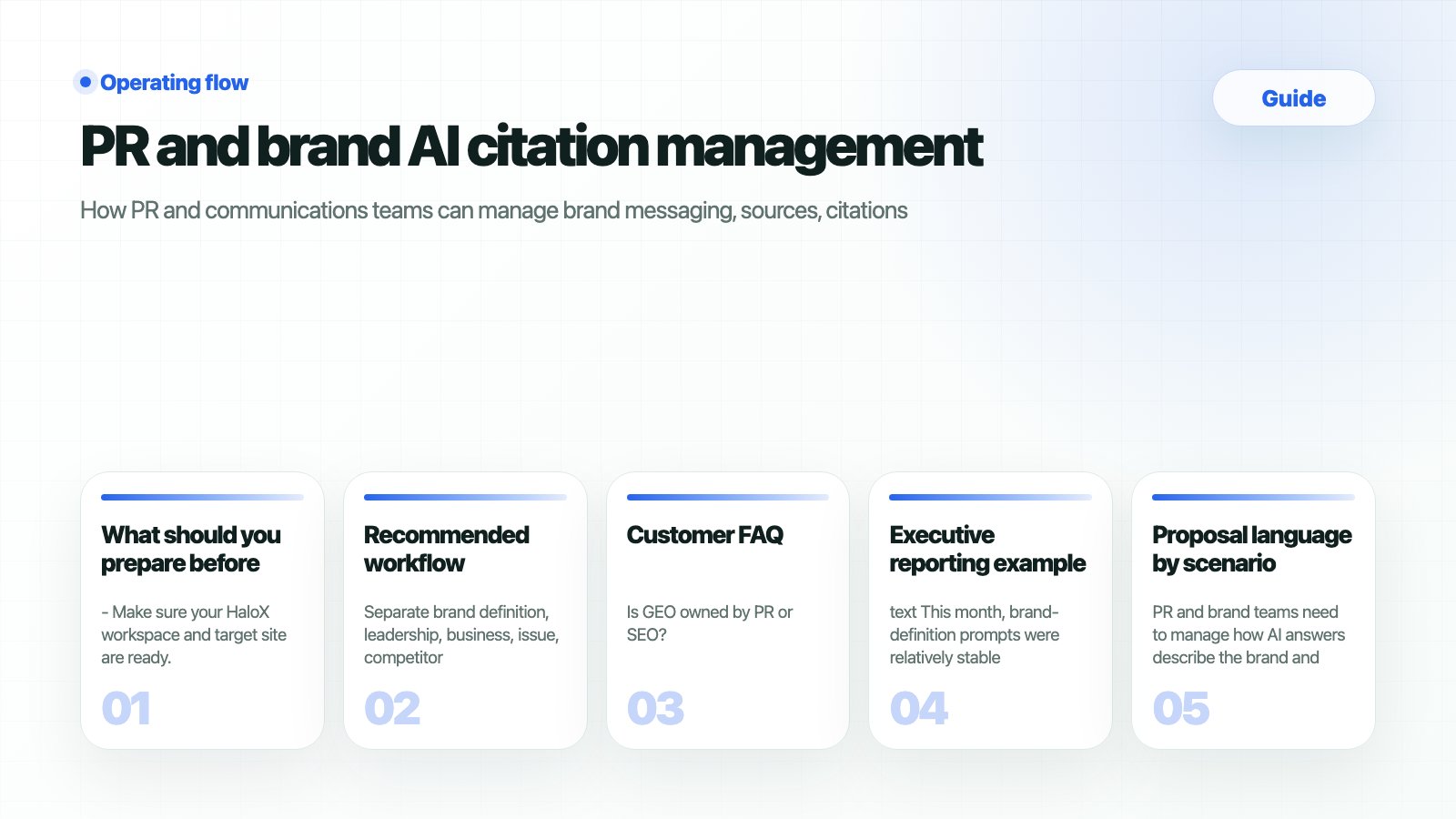
HaloX Guides page thumbnail summarizing PR and brand AI citation management in five cards
For PR and brand teams, GEO is not an education project. It is an operating system for understanding how AI answers describe the brand, which sources validate the message, and where competitors or external narratives shape the answer. Real communications meetings repeatedly focused on operating criteria, scoring, strategic questions, newsroom/YouTube diagnosis, and executive reporting evidence.

What should you prepare before starting?

  • Make sure your HaloX workspace and target site are ready.
  • Keep GSC/GA4 access and any existing SEO or meeting notes nearby.
  • Decide where the output will live: internal note, client report, or weekly operating document.

How do you verify the result?

CheckHealthy stateNext action
Workflow completedThe requested audit or reporting task is finishedReflect the result in Strategy Map and the right report
Priority selectedThe next keyword, page, or content opportunity is clearAssign an owner and due date
Evidence recordedThe metrics and reasoning can be reused in the next meetingTrack the same signals next week

What commonly blocks teams?

ProblemCauseFix
Scores are visible but next steps are unclearMetrics were not translated into execution unitsStart from Strategy Map GAP types and priority clusters.
It is hard to explain to customersTechnical signals were not converted into business languageAdd cause, impact, and next action to every report item.
Results do not change immediatelyAI answer surfaces need time to recrawl and reassess sourcesTrack the same prompt set and metrics weekly.

PR and brand questions from meetings

QuestionHaloX operating answerSurface
How does AI describe our brand?Track brand
leadership
issue
product
and comparison questions as a recurring prompt set.
Dashboard, top AI questions, citation tracking
Is a newsroom score enough?No. Explain which items are weak and why the assets are not citation-friendly.Site Audit, Content Factory Trust Report
How should press releases change?Add clear leads
FAQ
fact sheets
entity hubs
numbers
tables
and source links.
Content Factory
What belongs in executive reporting?Current diagnosis
comparison axis
prompt categories
early evidence
and next actions.
Weekly Reports, Export

Strategic prompt-set design

Question axisExamplePurpose
Brand definition“What does this company do?”Check whether official positioning is reflected
Leadership“What is known about the CEO/chairperson?”Monitor leadership and group-level questions
Business/product“What are the company’s main businesses?”Align product and entity descriptions
Issues“What are recent controversies or concerns?”Track reputation and issue framing
Comparison“How does company A differ from company B?”Understand competitive message position
Owned media“Are newsroom or YouTube assets cited?”Verify owned-source potential
1

1. Define brand prompt sets

Separate brand definition and leadership questions before writing content. Then split business, issue, competitor, and owned-media questions into their own sets.
2

2. Use Dashboard and citation rate as operating signals

AVI Overall Score, AVI, and citation rate help prioritize work. Do not present the score as the final outcome; explain what it reveals.
3

3. Audit newsroom and owned-media readiness

Check whether newsroom and blog pages have clear FAQ and fact sheets. YouTube and official pages should connect back to the same entity hub so AI answers do not rely only on third-party summaries.
4

4. Convert content into citation-friendly assets

Strengthen definitions, numbers, background, FAQ, comparison tables, and source links. Do not simply lengthen press releases.
5

5. Report in executive language

Explain which questions use which sources and what needs to change next instead of only saying GEO work is happening.

Customer FAQ

Is GEO owned by PR or SEO?

Both. SEO owns technical and search readiness. PR and brand teams own message, sources, newsroom assets, and issue questions. HaloX connects those surfaces through Site Audit, Strategy Map, Content Factory, and Weekly Reports.

Is it enough if AI cites news articles?

No. News coverage matters, but official sources provide message control. Without newsroom FAQ, fact sheets, and entity hubs, AI systems may rely more heavily on third-party summaries.

How should scores be used in executive reports?

Scores are prioritization signals, not the goal itself. The interpretation matters more: for example, “FAQ and fact sheets are missing, so AI systems have difficulty citing official assets.”

Should YouTube be included?

Often yes. Different AI engines use different channels, and Google/Gemini surfaces may rely more on Google ecosystem assets. Separate diagnostic scope from immediate execution scope.

Executive reporting example

This month, brand-definition prompts were relatively stable, but issue and comparison prompts showed source inconsistency.
The newsroom has authority, but FAQ, fact-sheet, and entity-hub structures are not yet citation-friendly.
Next, we will improve three sample newsroom assets and monitor citation rate and source changes through weekly reports.

Proposal language by scenario

PR and brand teams need to manage how AI answers describe the brand and which sources validate the message. FAQs, fact sheets, entity hubs, and newsroom structure often matter more than press-release volume.
Proposal sectionWhat to includeRelated doc
Current stateWeak areas across AVI
citation rate
source visibility
and web health
Reading scores
Priority prompt setBranded
non-branded
comparison
local
and buying-review questions
Prompt analysis
Execution assetFAQ
comparison table
entity hub
newsroom or blog improvements
Content Factory
VerificationWeekly movement across the same prompts and citation URLsReports

How to anonymize cases

Do not publish customer names, real URLs or meeting transcripts. Convert each case into an industry context, question type, HaloX screen and next action.