
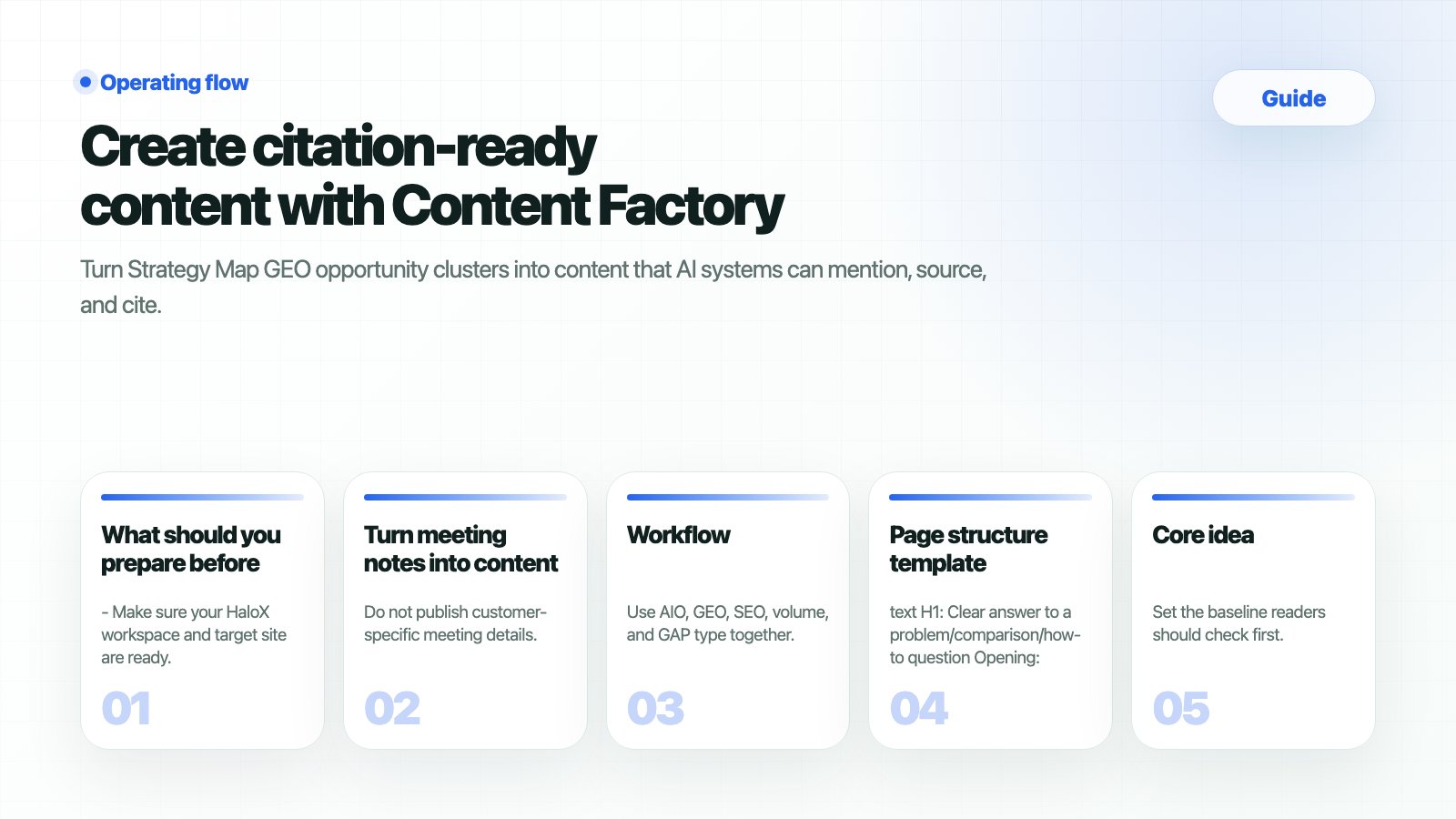
What should you prepare before starting?
- Make sure your HaloX workspace and target site are ready.
- Keep GSC/GA4 access and any existing SEO or meeting notes nearby.
- Decide where the output will live: internal note, client report, or weekly operating document.
How do you verify the result?
| Check | Healthy state | Next action |
|---|---|---|
| Workflow completed | The requested audit or reporting task is finished | Reflect the result in Strategy Map and the right report |
| Priority selected | The next keyword, page, or content opportunity is clear | Assign an owner and due date |
| Evidence recorded | The metrics and reasoning can be reused in the next meeting | Track the same signals next week |
What commonly blocks teams?
| Problem | Cause | Fix |
|---|---|---|
| Scores are visible but next steps are unclear | Metrics were not translated into execution units | Start from Strategy Map GAP types and priority clusters. |
| It is hard to explain to customers | Technical signals were not converted into business language | Add cause, impact, and next action to every report item. |
| Results do not change immediately | AI answer surfaces need time to recrawl and reassess sources | Track the same prompt set and metrics weekly. |
Best starting points
| Starting point | Use it when | Example |
|---|---|---|
| GEO opportunity cluster | Competitors appear in AI answers but your brand does not | “best tools for…”, “how to choose…” |
| Missing strategic prompt | A key buyer question does not mention your brand | “Which vendor should I consider?” |
| Site Audit issue | An existing page is hard for AI crawlers to read or understand | no schema, JS dependency, weak FAQ |
| Repeated customer-meeting question | Sales/onboarding teams hear the same question repeatedly | “How should we interpret this score?” |
Turn meeting notes into content briefs
Do not publish customer-specific meeting details. Convert them into anonymized industry scenarios and reusable question intent.| Meeting signal | Content brief | Content type |
|---|---|---|
| “Why doesn’t AI show our brand?” | Explain the difference between mentions, sources, and citations | Concept + diagnostic guide |
| “How is SEO different from GEO?” | Show GEO as an operating layer on top of SEO | Comparison landing page |
| “How do we report this to executives?” | Provide score interpretation, risk, and next-action templates | Reporting guide |
| “Do we need location-level visibility?” | Explain local GEO prompt sets and branch-page structure | Vertical playbook |
Workflow
1. Choose the execution cluster in Strategy Map
Use AIO, GEO, SEO, volume, and GAP type together. Prioritize
GEO opportunity and Urgent clusters.3. Review Strategy Analysis first
Validate the blueprint, pain points, format, and additional keyword opportunities before judging the draft.
4. Review Content Writing
Check the opening definition, headings, FAQ, comparison tables, sources, and schema potential.
Citation-ready checklist
| Element | Check |
|---|---|
| One-line definition | Can AI reuse a clear definition? |
| Question-based headings | Do H2/H3 sections match real user questions? |
| Comparison structure | Are alternatives, criteria, or trade-offs visible in tables? |
| Evidence | Are statistics official references examples and links present? |
| FAQ | Does the page answer repeated customer questions? |
| Schema | Can FAQPage, Article, or HowTo schema be applied? |
| Freshness | Are publish/update dates and current criteria visible? |
Vertical examples
PR/Brand
Turn media coverage, official statements, and FAQs into evidence candidates for AI answers.
B2B SaaS
Create comparison, selection-criteria, alternative, and ROI pages for non-brand discovery questions.
Financial/regulated
Structure official explanations, risk notices, and definitions with reliable sources and freshness signals.
Local/multi-location
Answer location + service questions with branch URLs, local context, and FAQ structure.
