
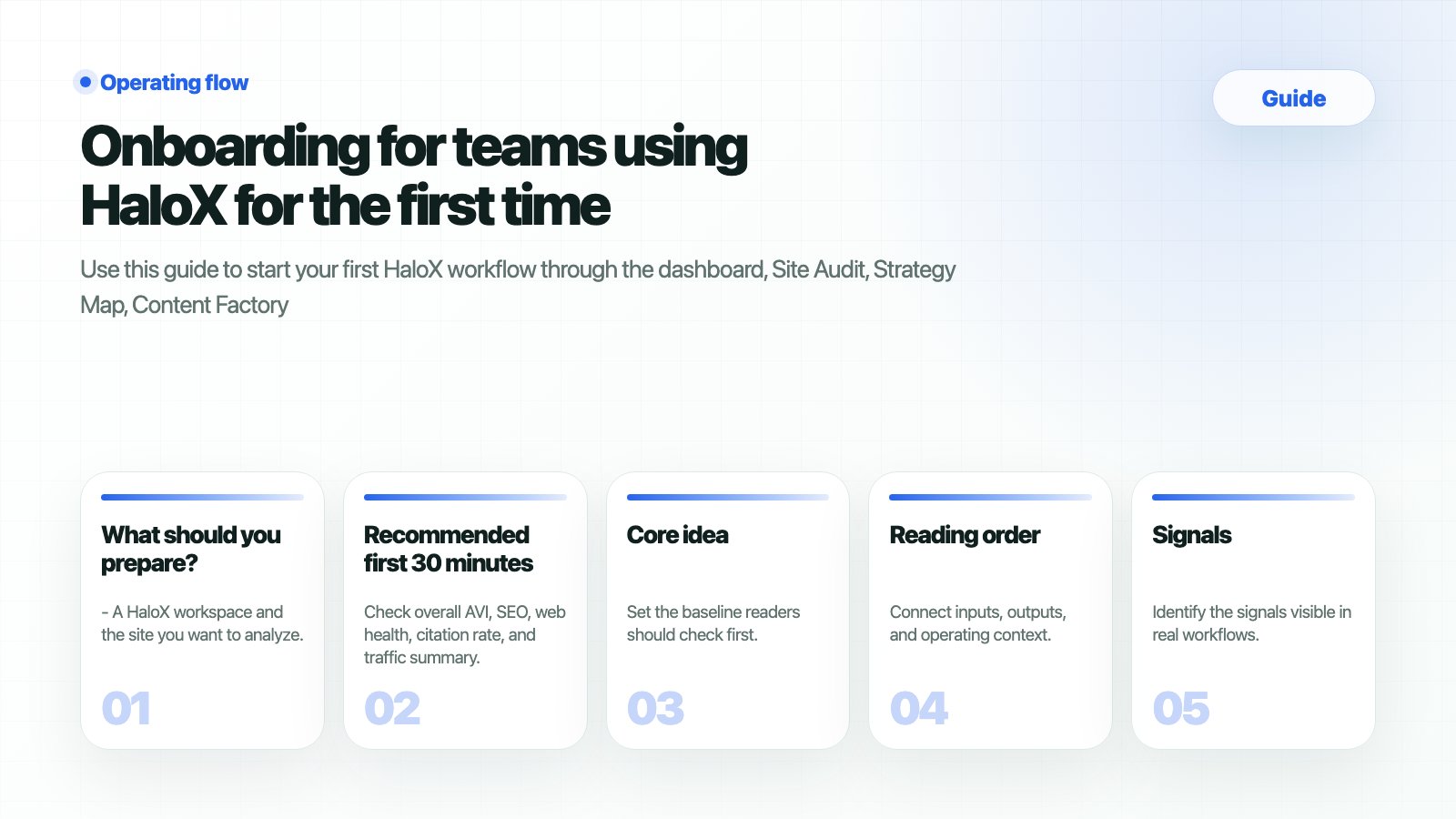

What should you prepare?
- A HaloX workspace and the site you want to analyze.
- Google Search Console, GA4, prior SEO reports, or meeting notes if available.
- 5–10 core questions your team or customer needs to answer.
- A place to record findings for internal or customer-facing follow-up.
How do you verify the result?
| Check | Good state | Next action |
|---|---|---|
| Current state | You understand AVI SEO web health and citation rate at a high level | Separate the causes by feature area. |
| Diagnosis | Site Audit shows important and warning issues | Split work into developer and content tasks. |
| Priorities | Strategy Map identifies urgent and GEO-opportunity clusters | Move work to Content Factory or tickets. |
| Deliverables | Drafts, fixes, or report sentences exist | Export and summarize in Weekly Reports. |
What commonly blocks teams?
| Problem | Cause | Fix |
|---|---|---|
| Scores are visible but action is unclear | Metrics were not translated into work items | Start with Strategy Map gap types and priority clusters. |
| Customer explanation is difficult | Technical metrics were not converted into business language | Add cause, impact, and next action to every report point. |
| Changes are not immediate | AI answers update through repeated crawling and evaluation | Track the same question set weekly. |
| Cluster choice is confusing | Keywords are treated like folders | Treat clusters as groups of questions AI may evaluate together. |
| Quota/error messages feel alarming | Request state is confused with output quality | Quota is usage-state information, not a judgment on your content. |
Recommended first 30 minutes
1. Review the dashboard
Check
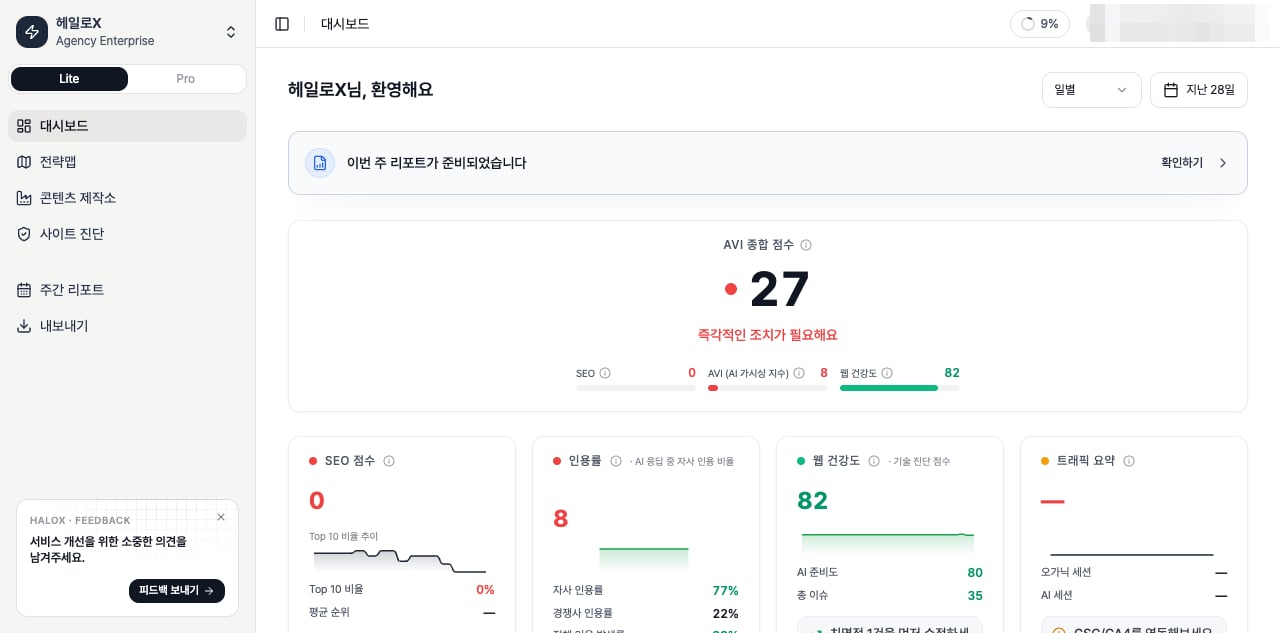
overall AVI, SEO, web health, citation rate, and traffic summary. Focus on which area is weak, with the score.2. Find causes in Site Audit
Review SEO, GEO, performance, schema, and crawlability issues. Separate developer work from content work.
3. Pick priorities in Strategy Map
Choose only 1–3 clusters for the week based on urgency, GEO opportunity, and gap type.
4. Create deliverables in Content Factory
Turn selected clusters into question-led content with definitions, comparisons, FAQ, and sources.
Terms first-time users confuse
| HaloX term | Plain explanation | Feature |
|---|---|---|
| AVI | Overall view of how visible your brand is in AI answers | GEO Dashboard |
| Strategic question set | Core AI questions to measure repeatedly | Prompt Analysis |
| Cluster | A group of related questions and keywords | Strategy Map |
| Citation rate | How often AI answers show your site as a source | Citation Tracking |
| GEO opportunity | A candidate topic where AI-answer visibility can improve | Strategy Map |
First explanation by audience
| Audience | Explain it this way | Show first |
|---|---|---|
| Executive | “The brand appears in AI search this way, and the next improvement is this.” | Dashboard, Weekly Reports |
| Marketing team | “We group keywords and questions to decide which content to create first.” | Strategy Map, Content Factory |
| PR/communications | “We check whether official messages and external sources shape AI answers.” | GEO Dashboard, Citation Tracking |
| Web/development | “We separate technical blockers that prevent AI and search engines from reading the site.” | Site Audit |
| Local team | “We connect local questions to branch pages and recommendation visibility.” | Strategy Map, local GEO guide |
Next docs
- Start technical work with Run your first Site Audit.
- Interpret metrics with Reading HaloX scores.
- Execute content with Create AI-citable content.
- Prepare reporting with Weekly Reports.
