
Documentation Index

Fetch the complete documentation index at: https://docs.haloxlabs.ai/llms.txt

Use this file to discover all available pages before exploring further.

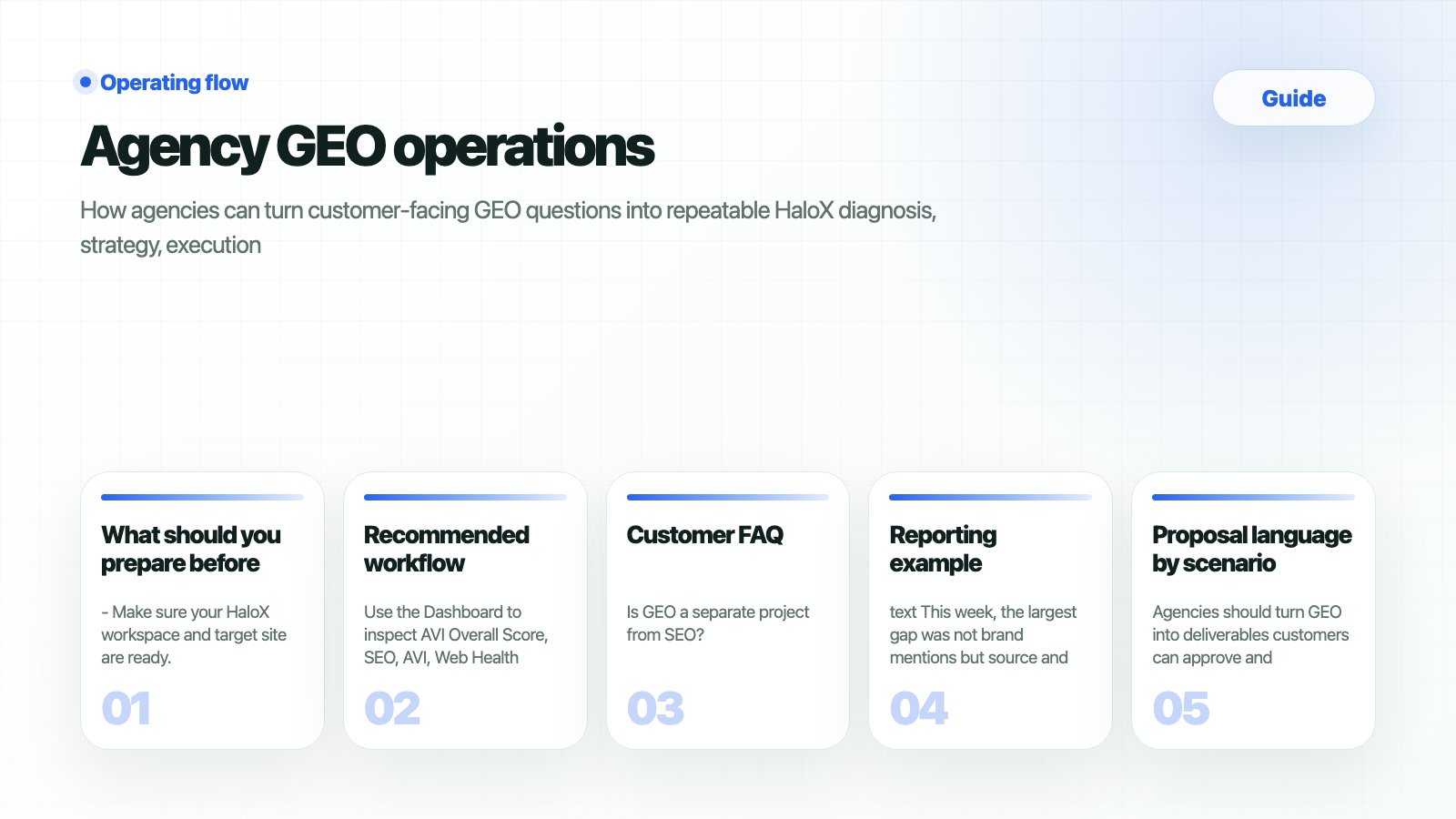
Agency GEO operations

Agencies rarely struggle with the definition of GEO. The harder question is how to package it for clients: what to diagnose, what to deliver, what to execute, and how to report progress. In customer and partner meetings, the clearest operating language was diagnosis → strategy → content/channel execution → weekly reporting.
HaloX vertical GEO scenarios

Questions that repeatedly came up in meetings

Client questionPublic answerWhere to look in HaloX
How do we productize GEO/AIO diagnosis?Package it as a diagnostic report, strategic prompt set, content execution plan, and weekly report—not as a one-off education session.Dashboard, Site Audit, Strategy Map, Weekly Reports
Are Naver, Google, ChatGPT, and Gemini the same?No. Separate search visibility, AI-answer visibility, and owned-media readiness by channel.Prompt sets, citation tracking, Strategy Map
How do we explain technical metrics simply?Translate mention/source/citation into: does the brand appear, is it used as evidence, and is it cited as a link?Citation rate, top AI questions, Content Factory Trust Report
What belongs in the first proposal?Scope, current weaknesses, priority questions, content types to fix, and a 2–4 week execution plan.Export, Weekly Reports
1

1. Establish the client baseline

Use the Dashboard to inspect AVI Overall Score, SEO, AVI, Web Health, and citation rate. In the first report, explain weak areas and why they matter rather than over-emphasizing the score.
2

2. Design prompt sets in client language

Separate brand, non-brand, comparison, buying, industry, and location questions. For clients, explain prompts as recurring strategic questions that AI systems answer.
3

3. Check technical readiness

Use Site Audit to inspect AI bot access, structured data, performance, JavaScript dependency, metadata, and headings. If SEO fundamentals are weak, propose SEO recovery before GEO expansion.
4

4. Prioritize in Strategy Map

Use AIO, GEO, SEO, GAP type, urgent clusters, and GEO opportunities together. Questions where competitors are repeatedly cited usually create the strongest client case.
5

5. Turn strategy into deliverables in Content Factory

Strengthen definitions, FAQ, comparison tables, evidence, and source links. For agencies, this is where analysis becomes visible execution.
6

6. Share progress with Weekly Reports and Export

Summarize changes, issues, content work, and next actions. Export the deliverables that need to be included in client decks or reports.
HaloX GEO operating loop

Agency service packages

PackageIncludesClient-facing deliverable
One-page diagnosisDashboard KPIs, Site Audit issues, AI-answer brand/competitor visibilityCurrent state, top risks/opportunities, next actions
2–4 week sprint20–50 strategic questions, urgent clusters, content improvement planPrompt set, priority content list, sample fixes
Monthly operationsRepeated audits, Content Factory execution, citation and visibility reportingWeekly/monthly reports and meeting summaries
Joint execution modelAgency runs PR/content; HaloX provides diagnosis, strategy, and verificationRole map, execution calendar, verification report

Customer FAQ

Is GEO a separate project from SEO?

Usually no. GEO sits on top of SEO readiness. Technical SEO, content structure, authority, schema, and bot access affect whether AI systems can use a brand as a source. HaloX connects Site Audit, Strategy Map, and Content Factory into one operating loop.

Is a brand mention enough?

No. Mentions are only the first layer. Track mention, source, citation, competitor co-visibility, and prompt-set coverage together. The stronger question is not “did the brand appear?” but “was the brand used as evidence for the right questions?”

How should we explain metrics to clients?

Mention means the brand appears. Source means the brand asset is used as evidence. Citation means the answer shows the asset as a link or reference. AVI should be positioned as an operating signal for AI-search visibility, not as a public fixed formula.

Do we need revenue attribution in month one?

Not necessarily. First establish the baseline: AI visibility, citation rate, competitor gaps, Site Audit issue reduction, and content-cluster progress. Revenue attribution is a later-stage measurement layer.

Reporting example

This week, the largest gap was not brand mentions but source and citation visibility.
Strategy Map identified three non-brand comparison clusters as GEO opportunities,
and Site Audit found structured-data and AI-accessibility issues.
Next week, we will use Content Factory to strengthen those clusters with FAQ, comparison tables, and evidence links.