
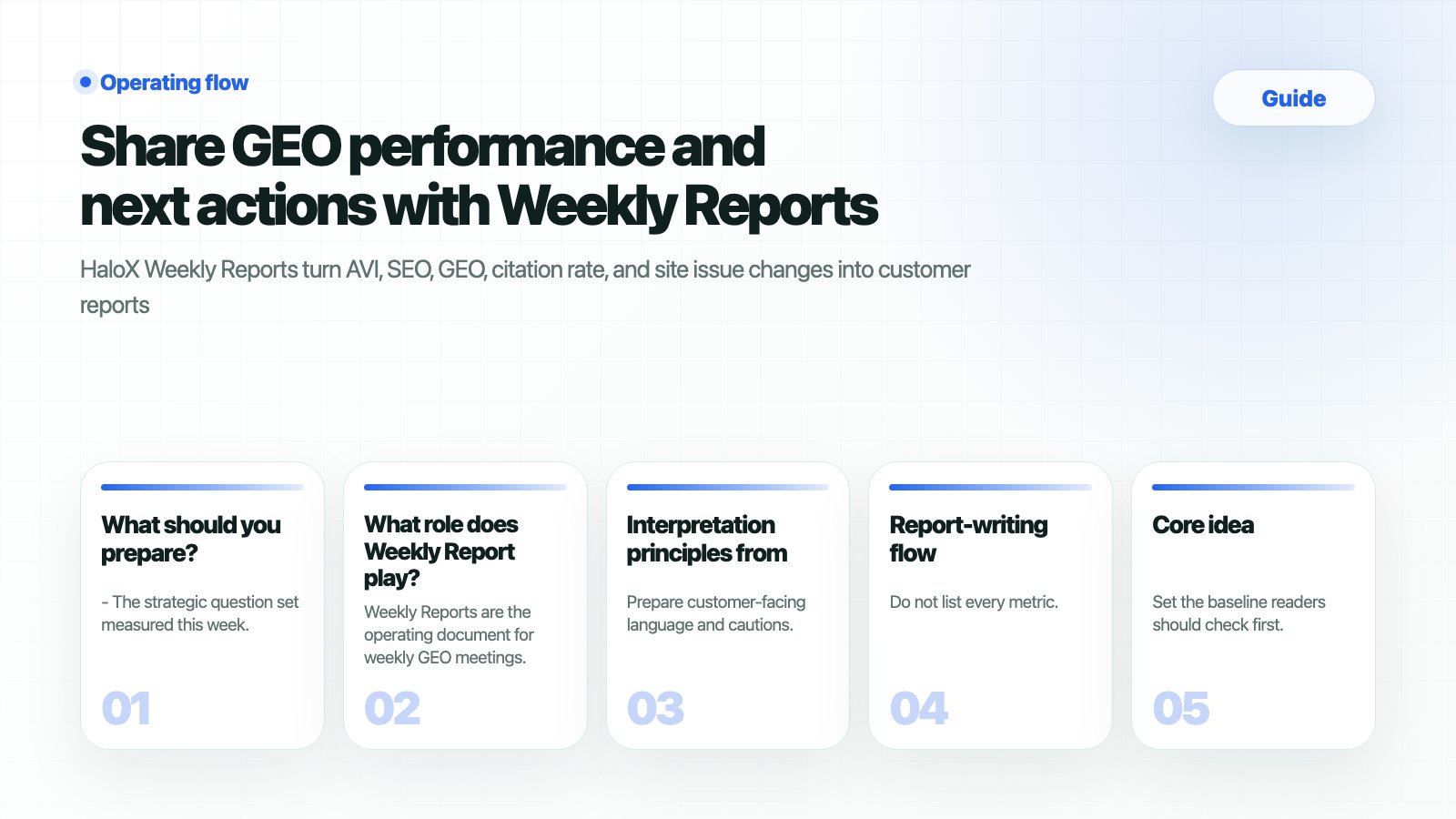
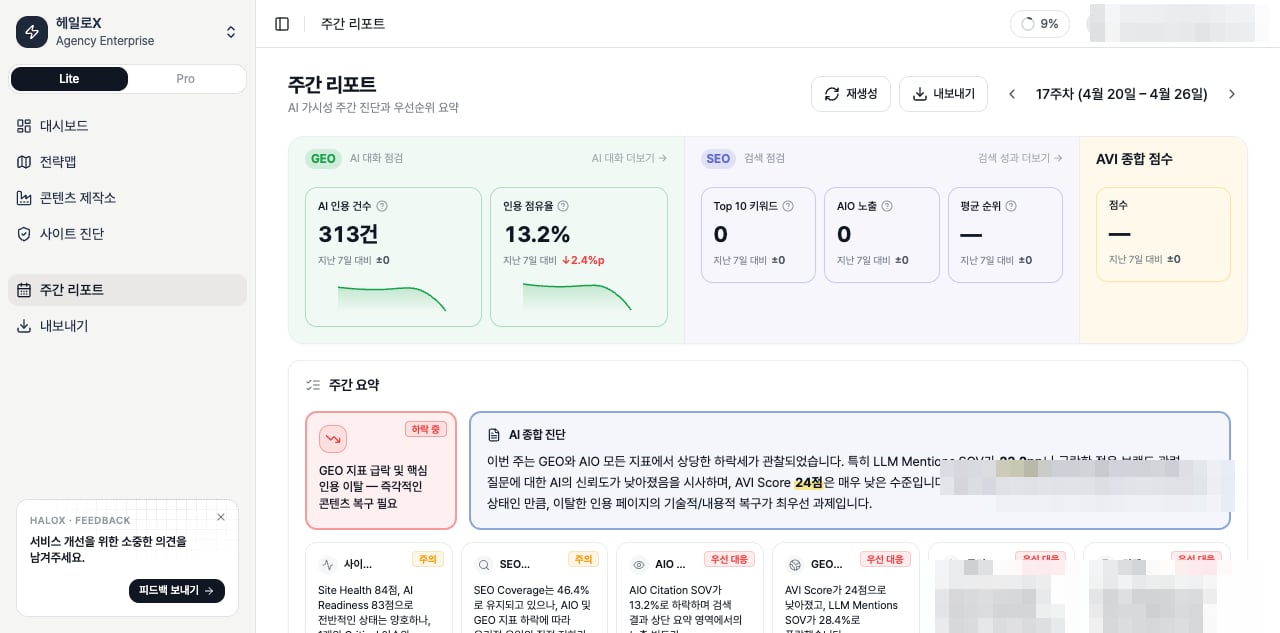
Weekly Reports summarize SEO/GEO changes and next actions. GEO is not a one-time diagnosis; it is a repeated operating loop of questions, citations, site fixes, content execution, and reporting.
What should you prepare?
- The strategic question set measured this week.
- Actions from Site Audit, Strategy Map, and Content Factory.
- A defined audience: executive, customer, internal team, or agency partner.
- Last week’s report if available, so the same metrics and questions can be compared.
How do you verify the result?
What commonly blocks teams?
What role does Weekly Report play?
Weekly Reports are the operating document for weekly GEO meetings.- Executives use it to understand AI-search brand position.
- Customers use it to see actions and next priorities.
- Internal teams use it to split development, content, and PR tasks.
- Agencies use it as the output of a diagnosis → strategy → execution → reporting package.
Report sentences by audience
Interpretation principles from meetings
1. GEO is an operating and verification system
It is not a one-time training session. Teams repeat the same question set and verify whether site, content, and source work changes AI answers.2. Separate mention, source, and citation
A brand can be mentioned without being cited. Reports should separate “the brand appeared,” “a source influenced the answer,” and “a link was cited.”3. Start with leading indicators
Early GEO should track AI exposure, question coverage, citation rate, source visibility, site issue reduction, and content cluster completion. Revenue attribution comes later.4. Separate SEO recovery from GEO expansion
If the SEO foundation is weak, explain the work as SEO recovery → content clusters → AI-answer entry, not immediate GEO expansion.Report-writing flow
1
1. Choose the top three changes
Do not list every metric. Pick the most important movement across AVI, citation rate, site issues, and content execution.
2
2. Connect changes to features
Show whether the evidence came from Site Audit, GEO Dashboard, Strategy Map, or Content Factory.
3
3. Split next actions by owner
Assign work to development, content, PR/brand, agency, or customer approval.
4
4. Translate metrics into executive language
“Citation rate is low” becomes “official sources are not yet used strongly as answer evidence.”
5
5. Measure the same questions next week
Changing question sets every week makes trend interpretation unreliable.
Next docs
- Interpret scores with Reading HaloX scores.
- Find question-level causes in GEO Dashboard.
- Choose priorities in Strategy Map.
- Execute content in Content Factory.