
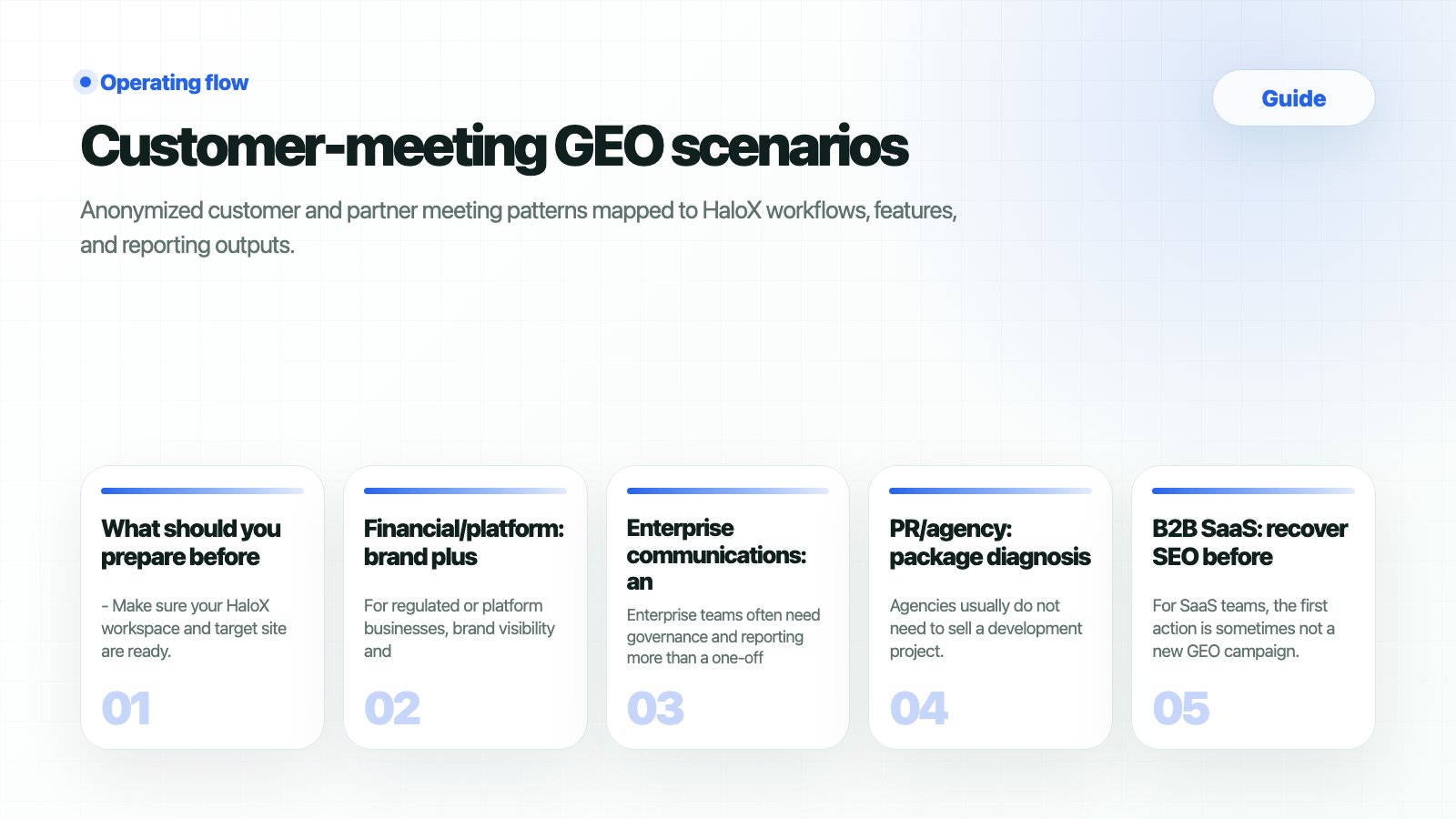
Customers rarely ask only “What is GEO?” In real sales and onboarding conversations, they ask how AI search affects their own brand, channel mix, content operations, and reporting. This guide turns those recurring conversations into anonymized public scenarios.Documentation Index
Fetch the complete documentation index at: https://docs.haloxlabs.ai/llms.txt
Use this file to discover all available pages before exploring further.
What should you prepare before starting?
- Make sure your HaloX workspace and target site are ready.
- Keep Google Search Console, GA4, existing SEO reports, or customer meeting notes nearby when available.
- Decide where the output will be recorded, such as an internal note, client report, or weekly operating document.
How do you verify the result?
| Check | Healthy state | Next action |
|---|---|---|
| Workflow completed | The audit, score review, content, or reporting task in this guide is finished | Reflect the result in Strategy Map, weekly reports, or client-facing notes |
| Priority selected | The next keyword, page, or content opportunity is clear | Assign an owner and due date |
| Evidence recorded | The metrics and reasoning can be reused in the next meeting | Track the same signals next week |
What commonly blocks teams?
| Problem | Cause | Fix |
|---|---|---|
| Scores are visible but next steps are unclear | Metrics were not translated into execution units | Start from Strategy Map GAP types and priority clusters. |
| It is hard to explain to customers | Technical signals were not converted into business language | Add cause, impact, and next action to every report item. |
| Results do not change immediately | AI answer surfaces need time to recrawl and reassess sources | Track the same prompt set and metrics weekly. |
Recurring questions from meetings
| Customer situation | What they ask | How to explain HaloX | Connected features |
|---|---|---|---|
| Financial or platform business | “Can we appear in non-brand conversion questions, not only brand search?” | Separate brand-defense questions from non-brand conversion questions, then monitor source and citation paths. | Site Audit, Prompt Analysis, Strategy Map |
| Enterprise communications team | “Can GEO become an operating and verification system?” | Score owned media, define recurring strategic prompt sets, and report evidence for executives. | GEO Dashboard, Citation Tracking, Weekly Reports |
| PR or agency team | “How do we package GEO/AIO for clients?” | Sell one-page diagnosis, 2–4 week sprints, monthly operations, and shared execution. | Dashboard, Export, Agency guide |
| B2B SaaS team | “If SEO dropped, should we start with GEO?” | Recover search foundations first, rebuild topic clusters, then expand into AI citation monitoring. | Site Audit, Keyword Clusters, Content Factory |
| Local or multi-location business | “How do we monitor local questions and branch URLs?” | Select priority branches, URLs, and service categories before building local prompt sets. | Local GEO guide, Strategy Map, Weekly Reports |
1. Financial/platform: brand plus non-brand conversion questions
For regulated or platform businesses, brand visibility and conversion questions are different jobs.| Operating axis | What to do | Where in HaloX |
|---|---|---|
| Brand defense | Check whether AI answers describe the brand and official services accurately. | AVI, citation rate, top AI questions |
| Non-brand expansion | Track “how to,” “best,” “comparison,” and “before signing up” questions. | Prompt Analysis, Strategy Map |
| Trust foundation | Find weak third-party pages, bot-access issues, schema gaps, or thin explanations. | Site Audit, Web Health |
| Global/English | Separate Korean and English assets because source pools can differ by model and locale. | Content Factory, Citation Tracking |
“Showing up for brand search is not the same as being selected in pre-purchase questions. HaloX separates those question sets and checks which sources AI systems use as evidence.”
2. Enterprise communications: an operating system, not a lecture
Enterprise teams often need governance and reporting more than a one-off GEO explanation.| Output | What it includes | HaloX role |
|---|---|---|
| Current-state diagnosis | Newsroom, official site, fact sheet, English assets, and AI-citation readiness. | Site Audit, GEO Dashboard |
| Comparison axes | Competitors, affiliates, owned media, YouTube, and issue topics. | Citation Tracking, Share of Voice |
| Strategic prompt set | Brand, leadership, issues, business, global, and product questions. | Prompt Analysis |
| Execution backlog | FAQ, fact sheet, entity hub, English PR templates, schema fixes. | Content Factory, Export |
| Executive reporting | Explain why a weakness exists and what changes next month. | Weekly Reports |
3. PR/agency: package diagnosis, strategy, execution, and reporting
Agencies usually do not need to sell a development project. GEO works better as a differentiated diagnosis and operating package.| Package | Client value | Deliverables |
|---|---|---|
| One-page diagnosis | Makes current risks and opportunities obvious. | KPI summary, three weaknesses, ten priority questions |
| 2–4 week sprint | Turns question clusters into content and channel actions. | Prompt set, priority content list, sample rewrite |
| Monthly operations | Tracks citation rate, competitor mentions, and channel changes. | Weekly/monthly report, export package |
| Shared execution | Agency executes PR/content while HaloX provides diagnosis and verification. | Role split, execution calendar |
4. B2B SaaS: recover SEO before expanding GEO
For SaaS teams, the first action is sometimes not a new GEO campaign. It is repairing the search and content structure that AI systems depend on.1. Find the dropped category keyword
Check rankings, titles, meta descriptions, categories, tags, and internal links.
2. Rebuild topic clusters
Connect definition, comparison, how-to, FAQ, and case pages instead of publishing one-off posts.
3. Expand into adjacent questions
After the core topic recovers, move into related problem, alternative, automation, and agent questions.
5. Local/multi-location: fix scope before measurement
Local GEO starts with scope: which branch, which URL, which category, and which location questions.| Question group | Example | Content response |
|---|---|---|
| Local recommendation | “Best clinic in Gangnam,” “English academy in Seongsu” | Location landing page, branch FAQ, review structure |
| Before visiting | “Is parking available?”, “Is English support available?” | Branch fact sheet, hours, access information |
| Service comparison | “How to choose this treatment/service?” | Comparison table, cautions, selection criteria |
| International users | “Korean clinic for foreigners” | English guide, global FAQ, channel-specific sources |
Turning meeting language into public docs
| Internal meeting language | Public documentation language |
|---|---|
| Specific customer name, domain, or score | Anonymized vertical scenario |
| Prompt | Strategic prompt set / core questions AI receives |
| Cluster | Topic or keyword group |
| Mention/source/citation | Name appears / used as evidence candidate / cited as a link or source |
| Prove revenue attribution | Start with leading indicators: AI exposure, citation rate, question share, site visits, and issue reduction |
